All-in-one software platforms are often marketed as the safest choice for security guard companies. One system. One vendor. One place to manage everything. On paper, it sounds efficient and modern. In practice, it often forces businesses into rigid workflows that prioritize vendor control over operational excellence, and that is why security guard software integrations matter more than all-in-one platforms.
The real question is not whether software can do everything. It is whether it should. In an industry built on people, accountability, and execution, the difference between integrated systems and locked-in platforms shows up quickly in client retention, margins, and long-term value.
This article is not about features. It is about a philosophy.
The flaw in all-in-one security software thinking
The appeal of all-in-one software is simplicity. Fewer vendors to manage. Fewer logins. Fewer decisions. But simplicity at the surface often hides complexity underneath. When a platform insists that every function must live inside its walls, customers are forced to adapt their business to the software instead of the software adapting to the business.
That tradeoff is rarely discussed honestly. All-in-one platforms optimize for uniformity and control, not flexibility or excellence. Over time, that rigidity becomes friction, especially for growing security companies whose operations are anything but static.
What specialization teaches us about building better systems
If you were building a house, you would never ask one person to do everything, no matter how talented they were. Even the best carpenter in the world should not be doing your electrical or plumbing. Not because they are incapable, but because those are entirely different disciplines requiring different expertise, tools, and focus.
Instead, you hire specialists. A carpenter for the structure. An electrician for the wiring. A plumber for the pipes. You coordinate the work so it fits together cleanly, but you do not confuse coordination with consolidation.
If you did, you would eventually find yourself sitting on a wooden toilet seat, wondering how you managed to get a splinter in your bum.
Specialization exists because excellence requires focus. Software is no different.
The same mistake shows up in security guard companies
This tradeoff between breadth and mastery plays out inside the security industry every day.
Some security guard services companies try to be good at everything. They do retail, healthcare, residential, construction, executive protection, events, and fire watch. They say yes to every opportunity because versatility feels like strength and growth feels like progress.
Other companies take a different approach. They specialize. They focus deeply on a specific environment, client type, or risk profile. They refine training. They understand expectations at a level generalists rarely reach. Over time, the difference between specialists and their competitors becomes clear. Specialized security companies retain customers longer because they deliver on promises, not just make them. They command higher rates because they are not interchangeable. And when it comes time to sell, they are valued more highly because they are masters of something specific rather than average at many things.
The market rewards focus, even when it claims to want flexibility.
Why security guard software integrations outperform all-in-one platforms
Security guard software follows the same pattern.
When a platform tries to be all-in-one, it is making a philosophical choice. It is choosing breadth over depth, control over adaptability, and vendor convenience over customer outcomes.
This is where security guard software integrations become a competitive advantage.
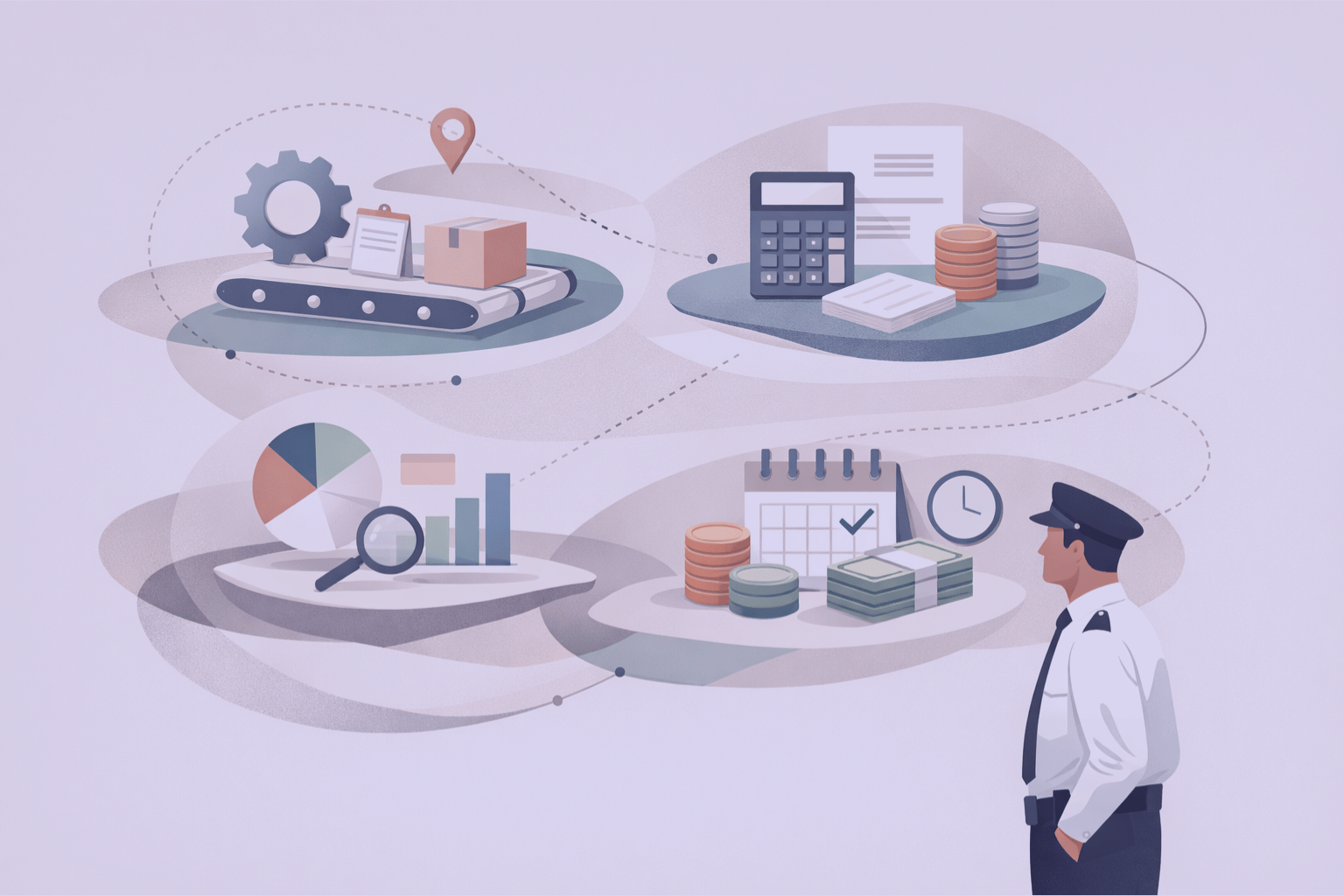
Integrated systems allow each tool to do what it does best while sharing accurate data across the business. Instead of forcing accounting, payroll, reporting, and operations into a single compromise platform, integrations allow security companies to build a technology stack that reflects how their business actually operates.
Integration does not create more complexity. It reveals it honestly and manages it intentionally.
Why we chose integration over lock-in
He at OfficerApps, we made a deliberate decision not to try to be everything to everyone.
Just as the strongest security companies choose a lane and master it, we chose to focus deeply on what we do best: field operations, scheduling, reporting, accountability, and visibility. That is our discipline. That is where we invest our time, energy, and attention.
Rather than attempting to rebuild existing, already successful software categories, we chose to embrace security guard software integrations as a core strategy.
Accounting and invoicing are clear examples.
Instead of forcing customers into a proprietary billing or accounting workflow, we chose to integrate with Intuit QuickBooks. That allows our customers to transition seamlessly from field management and reporting to the most widely trusted small- and mid-sized business accounting platform with minimal friction.
That decision was not about convenience. It was about respect for specialization.
Accounting and payroll are not side features
As security companies grow, payroll becomes one of the most complex and risk-sensitive parts of the business. Time worked in the field, overtime rules, pay rates, and compliance requirements all need to flow accurately into payroll systems without manual intervention.
Rather than attempting to rebuild payroll inside a field operations platform, we are extending the same integration-first philosophy into payroll systems as well. Done correctly, this reduces the anxiety that comes from knowing payroll depends on accurate field data and removes the manual steps that introduce doubt at exactly the wrong moment.
The goal is not to own payroll. The goal is to ensure the data driving payroll is accurate, timely, and connected to systems designed to handle it properly.
Integration is about outcomes, not control
There is a fundamental difference between integration and lock-in. Lock-in says, “Use our platform for everything, whether it fits or not.” Integration says, “Use the best tools available and let them work together.”
One approach prioritizes vendor control. The other prioritizes customer outcomes.
Just as specialized security companies outperform generalists over time, focused security software platforms that integrate well consistently serve customers better than those that insist on owning every function.
Focus scales better than trying to be everything
Choosing not to be everything is not a limitation. It is discipline.
It allows deeper expertise, clearer priorities, and better long-term outcomes. It allows security companies to assemble software systems that support how their business actually operates instead of forcing the business to adapt to rigid tools.
No serious client hires a security company because it claims it can do everything. They hire the company that proves it does one thing exceptionally well.
We believe security guard software should work the same way.
And this same principle will continue to guide how we think about integrations across the business, because focus scales better than control, and specialization ages better than sprawl.
By Courtney Sparkman
 Courtney is the founder and CEO of OfficerApps.com, a security guard company software provider and publisher of Security Guard Services Magazine. He is a renowned author and security industry syndicator who also hosts an active YouTube channel, helping thousands of his subscribers to grow their security guard services companies.