Growth in the security guard industry is often measured by the number of security guard contracts a company wins. More contracts usually mean more revenue, more non-billable roles you can support, and a stronger market presence. On the surface, as a security guard company, you would seemingly be moving in the right direction.
Over time, however, many security company owners and managers come to recognize a more complex reality. Not all security guard contracts contribute to healthy growth. What’s that saying, “Not all money is good money”?
Some contracts, particularly those you win under excessive downward pricing pressure, can quietly limit your company’s ability to scale. Although they often do not create immediate problems, they introduce operational strain that extends far beyond that single account. Understanding this is critical. Growth is not just about adding security guard contracts. It is about adding the right ones!
The Illusion of Growth
I’ll be the first one to admit that winning a new security guard contract very often feels like real progress. The pipeline converts, revenue increases, and the business appears to be expanding. From a distance, everything is looking positive.
But operationally, the picture can look very different. As you know, each contract introduces staffing requirements, supervisory needs, reporting expectations, and client communication. When pricing is tight, those demands do not scale efficiently. Instead, they start putting a drag on your company.
As more security guard contracts are added under constrained margins, management time becomes stretched, supervisors shift from being proactive to reactive problem-solving, and consistency across sites becomes harder to maintain. Although the company has grown in size and revenue, its underlying operations have become more fragile and less sustainable.
A Lesson From One Security Guard Contract
This dynamic became clear to me early on in my security career. In one case, I won a client who negotiated a VERY low rate for his security guard contract. We were a relatively new company, and although I knew we shouldn’t have gone that low, I needed to put revenue on the books, so I took the contract. At the time, signing the contract felt like the right decision.
Over time, the reality of that contract drastically changed the way I thought about winning contracts. The account required significantly more attention than expected or priced. There were frequent issues that required my father’s or my involvement because we were unable to hire the level of security officer or supervisor we needed at the site, due to the low billing rate. That level of management involvement at the site exceeded what the pricing could justify.
The time we invested in that one security guard contract left less time for us to continue growing and scaling our business. The impact was gradual, but accrued over time. Service quality across other accounts began to decline, our response times slowed, and small issues on other contracts weren’t resolved quickly enough, leading to the loss of those contracts. I realized too late that this one low-billing-rate contract had impacted the performance of the entire operation.
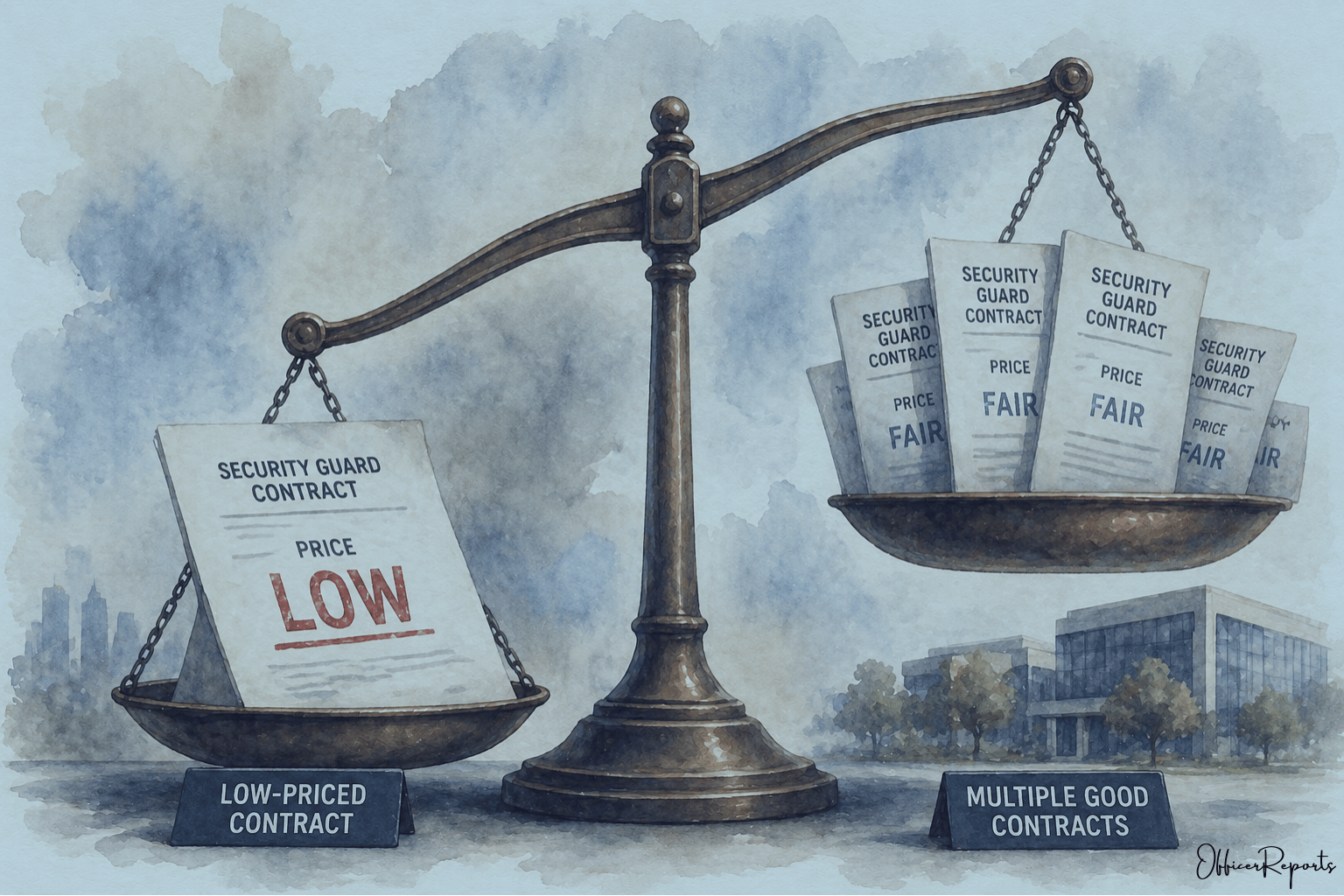
The lesson became crystal clear. A low-priced security guard contract can affect your entire portfolio.
How Certain Security Guard Contracts Limit Growth
As you can see from my example, some security guard contracts require a disproportionate share of resources. They require more communication, more oversight, and more direct involvement from leadership. Over time, this creates constraints that limit growth if not priced appropriately.
Contracts that require excessive management attention is often the first sign of upcoming problems. When leadership is unexpectedly and repeatedly drawn into one account, it reduces your ability to oversee the rest of your business or focus on long-term initiatives. Your growth becomes reactive instead of intentional.
Contracts won because of bottom-of-the-barrel pricing are another category to be wary of. Security guard contracts won at low margins reduce the company’s ability to invest in training, supervision, and operational systems. These investments are what drive consistency and long-term performance. Without them, the operation becomes more strained.
No matter the reason, misaligned contracts have a broader effect on standards. When one contract operates outside of your normal operational boundaries, it can begin to influence how others are managed. Your decisions as an owner will be shaped more by the limitations you face due to misaligned contracts than by the drivers of strong performance.
Why Security Companies Keep the Wrong Clients
Despite these challenges, many companies continue to hold onto misaligned security guard contracts. The reasons are real.
Revenue is difficult to walk away from. There is also a tendency to justify the decision because winning the contract required effort, and letting it go can feel like losing ground.
In some cases, there is optimism that the contract will improve over time or that efficiencies will eventually offset the low price.
In other cases, the idea of “letting” a competitor win the contract can push companies to accept terms that do not align with their operational needs.
Each individual decision may seem reasonable, but over time, those decisions shape the structure of the business.
The Operational Impact of Winning the Wrong Security Guard Contracts
The effects of a “bad” contract rarely just affect that one site. Leadership and supervisors spend more time managing issues at that site and less time improving performance across the portfolio. Scheduling becomes more difficult as teams try to fill low-paying posts. Response times to other customers can slow down because your managerial, administrative, or supervisory resources are stretched.
Over time, the company’s overall performance begins to reflect the operations of that one particular account. This is a critical inflection point. It means the business is no longer defined by its best security guard contracts but by those that require the most effort to maintain.
Rethinking What Growth Means
Sustainable growth requires a more selective approach to security guard contracts. It is not enough to add volume. The contracts need to align with how the business is designed to operate.
That alignment starts with pricing. Contracts must support the level of service the company intends to deliver. It also includes expectations. Clients should allow the company to perform effectively rather than force constant adjustments after the site has been taken over.
This shift requires discipline. It means evaluating opportunities not just by revenue, but by long-term impact. Turning down or restructuring a contract can feel counterintuitive, but it often creates capacity for better opportunities.
Over time, this selectivity leads to a stronger portfolio. Margins improve, operations stabilize, and the company becomes more consistent in how it delivers service.
A More Sustainable View of Winning Security Guard Contracts
Not all security guard contracts contribute equally to your business’s health. Some support stability, strong margins, and long-term relationships. Others introduce complexity that outweighs their value. That difference becomes clear over time in how you perform on each contract and how that affects the rest of the operation.
For security company owners, the key is to define growth more carefully. Growth is not simply the accumulation of security guard contracts. It is the deliberate building of a portfolio that the business can support at a high level.
When viewed this way, the focus shifts from winning more contracts to building a company that performs well as it grows. That distinction is often what separates companies that scale successfully from those that remain under constant operational strain.
By Courtney Sparkman

 Courtney is the founder and CEO of OfficerApps.com, a security guard company software provider, specializing in security guard management software, and publisher of Security Guard Services Magazine. He is a renowned author and security industry syndicator who also hosts an active YouTube channel, helping thousands of his subscribers to grow their security guard services companies.