Most security guard companies do not struggle to win security contracts because they lack capability. They struggle because, during the sales process, that capability is not visible to the buyer in a meaningful way. As a result, proposals begin to sound the same. Every company emphasizes professionalism, responsiveness, strong supervision, and a commitment to safety. From the buyer’s perspective, these claims blur together.
Over time, this creates a predictable outcome. When differences are unclear, the decision shifts toward what can be easily compared…Price. Price becomes the most visible variable, not because it is the most important, but because it is the only thing that feels concrete. In that environment, even strong operators find themselves competing on the same terms as everyone else when trying to win security contracts.
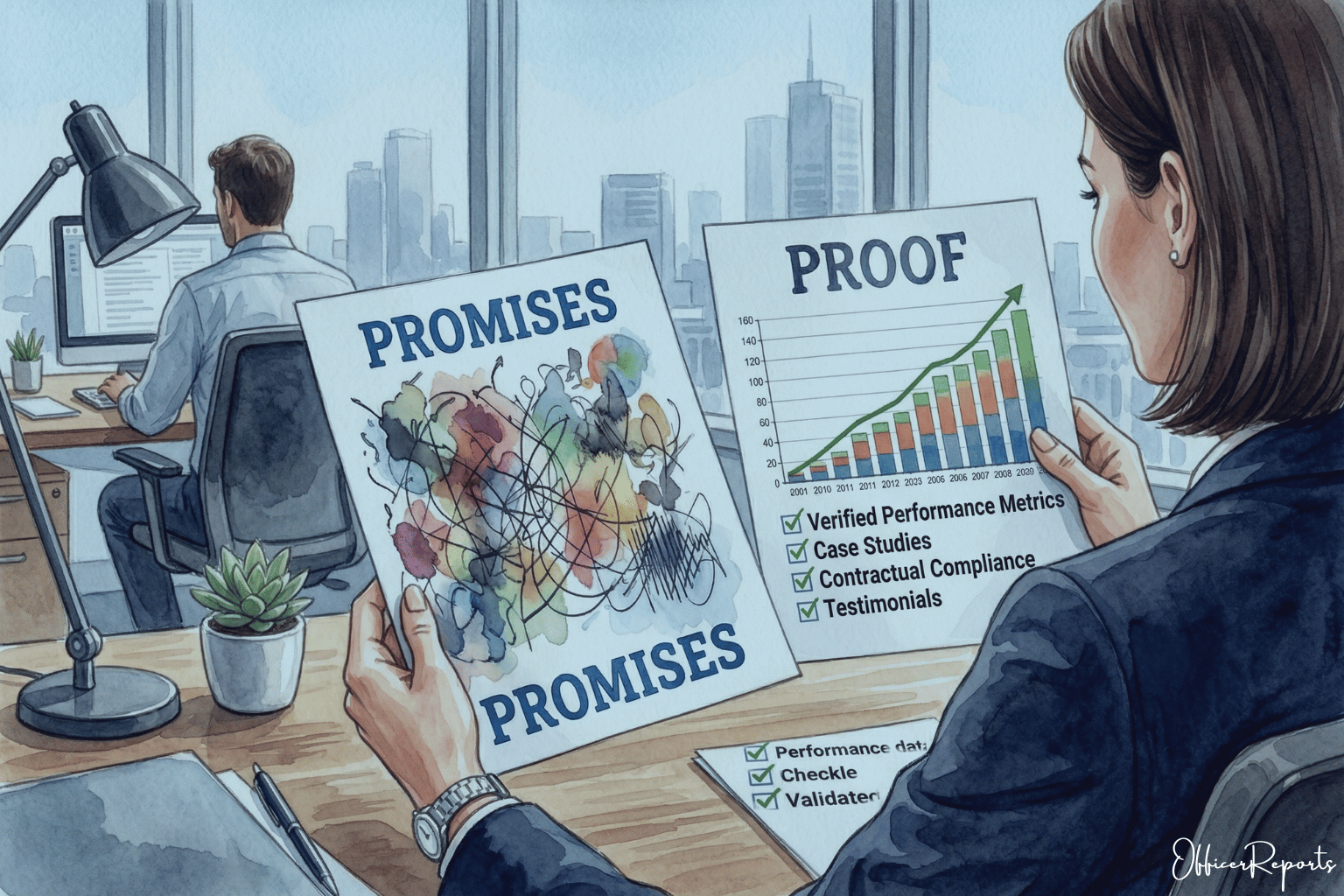
The issue is not that security companies are making the wrong promises. It is that promises, on their own, no longer carry weight. Buyers have heard them all before, and without something more tangible, those claims do not reduce uncertainty.
What Buyers Actually Trust When Awarding Security Contracts
When a buyer reviews proposals, their primary concern is not identifying the absolute best provider. Their focus is on avoiding a decision that creates problems later. A failed contract can lead to incidents, internal scrutiny, and reputational damage. That context shapes how decisions are made.
Because of this, trust is not built through confident language or well-written proposals. It is built on evidence. Buyers are looking for signals that show how a company performs in real environments, not how it describes itself in a proposal. They want to understand what will actually happen after the contract is signed.
This is where many companies misread the situation. They assume that improving how they describe their service will help them win security contracts. In reality, trust increases when the buyer can see proof of how the service operates, how issues are handled, and what outcomes are consistently delivered.
As Michael Silva from Silva Consultants said:
Almost every proposal I see says something along the lines of “we are not the cheapest, but if you are looking for the very finest in security, we are the one” or “we have the most qualified people” or “we provide better training”, ” we use the latest technology” etc. without providing anything to back it up. Talk is cheap.
Why Most Companies Struggle to Win Security Contracts With Proof
Don’t get me wrong, most companies do include some form of proof in their process, but it rarely has the intended impact. The issue is not the absence of proof. It is how that proof is structured and presented.
In many cases, proof is too generic to be meaningful. Client testimonials speak in broad terms about satisfaction, references confirm that a company is reliable, and case studies focus on activity rather than outcomes. While none of this is incorrect, it does not give the buyer a clear picture of what differentiates one provider from another.
Another common issue is that proof is not tied to outcomes. Companies describe what they do, but not what results from those actions. A patrol program may be detailed, but the buyer is left to infer how that translates into risk reduction or improved site performance. Without that connection, the proof feels incomplete.
Timing also plays a role. Proof is often introduced late in the process, typically within the proposal itself. By that point, the buyer has already begun forming comparisons between vendors. If the early conversations did not establish clear differentiation, it becomes difficult for late-stage proof to help win security contracts.
Finally, proof is often not visible during the sales process. It exists within the operation, but it is not translated into something the buyer can easily understand. As a result, the company’s strongest advantages remain internal rather than becoming part of the decision framework.
What Proof Looks Like When You Win Security Contracts Consistently
Real proof in security services is grounded in observable performance. It shows how the operation functions under real conditions and what outcomes are consistently produced. This goes beyond describing processes and focuses on demonstrating results.
Examples of real proof often include how incidents are identified and resolved, how consistently post orders are followed across sites, and how supervision impacts officer performance over time. These are not abstract claims. They are visible patterns that reflect how the business operates.
The distinction between activity and outcome is important here. Activity answers the question of what is being done. Outcome answers the question of what changes as a result. Buyers are ultimately trying to understand outcomes, because outcomes are what affect their risk.
When proof highlights specific, observable results, it allows the buyer to move from assumption to understanding. Instead of hoping that a process will work, they can see evidence that it has worked in comparable situations. This is what allows companies to win security contracts without relying on price alone.
How to Use Proof to Win Security Contracts in Practice
Using proof effectively requires translating internal operations into something that can be understood externally. Most security companies already generate meaningful data and insights through their day-to-day operations. The challenge is to convert that information into clear evidence that a buyer can evaluate.
This often begins by looking at how performance is tracked internally and asking a simple question. If a prospective client were to see this, would it help them understand the quality of the service? If the answer is no, the information needs to be reframed. Internal metrics must be connected to client-relevant outcomes such as reduced incidents, improved compliance, or increased visibility across sites.
Introducing proof early in the sales process changes the dynamic of the conversation. Instead of waiting until the proposal stage, operators can begin showing how their service works during initial discussions. This gives the buyer a framework for evaluating the company before comparisons are made and increases the likelihood that they will win security contracts.
Matching proof to the buyer’s concerns is equally important. Different buyers prioritize different outcomes. Some are focused on consistency across locations, while others are more concerned with incident response or reporting visibility. When proof is aligned with those concerns, it becomes more relevant and easier to interpret.
Let’s not forget that clarity matters as well. Proof should not require interpretation. If the buyer has to analyze or decode what they are seeing, it loses effectiveness. The goal is to make the evidence simple enough that it can be understood quickly and explained easily to others.
This becomes particularly important when discussing pricing. When proof is used to show how the service operates and what outcomes it produces, pricing can be framed in context. Instead of appearing as a standalone number, it becomes part of a broader discussion about tradeoffs.
Helping Buyers Justify Decisions and Win Internal Approval
In most security contract decisions, the person evaluating vendors is not the only stakeholder involved. Finance teams, procurement groups, and senior leadership often play a role in the final decision.
The buyer is not just choosing a provider. They are also responsible for defending that choice internally. If they select a higher-priced option, they need to explain why that decision reduces risk or creates better outcomes. Without clear evidence, that explanation becomes difficult.
Proof gives the buyer something concrete to work with. It provides language, examples, and outcomes that can be shared with others. Instead of relying on general statements, the buyer can cite specific evidence to support the decision.
For this to work, the proof must be easy to communicate. Complex data or overly detailed reports are less effective if they cannot be summarized clearly. The goal is to provide information that can be repeated accurately in internal discussions.
Connecting proof directly to risk reduction is often the most effective approach. When the buyer can show how a particular aspect of your service reduces the likelihood of issues or improves response when they occur, the decision becomes easier to justify. This is a key factor in whether a company can consistently win security contracts.
Where Security Contracts Are Won or Lost
At a certain point in the sales process, the buyer begins to compare options more directly. If the information available at that stage does not clearly differentiate providers, the comparison tends to default to price.
Without proof, even strong operators can appear similar to less capable competitors. The proposal becomes a document of claims rather than a reflection of performance. In that environment, pricing differences carry more weight than they should, making it harder to win security contracts without lowering prices.
When proof is present and clearly understood, the nature of the comparison changes. The buyer is no longer evaluating a set of similar promises. They are evaluating different levels of demonstrated performance. This makes the decision more defensible and reduces the pressure to compete solely on price.
Conclusion
In a market where most companies describe their services in similar ways, clarity becomes a competitive advantage. Proof is what creates that clarity. It allows the buyer to see how a company actually operates, what outcomes it produces, and how those outcomes reduce risk.
For security company owners, this shifts the focus away from improving how the service is described and toward improving how it is demonstrated. The goal is not to make stronger claims, but to make the operation visible in a way that the buyer can understand and explain.
When proof is integrated into the sales process, pricing does not disappear from the conversation. It simply becomes one part of a broader evaluation. At that point, companies that consistently win security contracts are not the ones making the strongest promises, but the ones providing the clearest proof.
By Courtney Sparkman

 Courtney is the founder and CEO of OfficerApps.com, a security guard company software provider, specializing in security guard management software, and publisher of Security Guard Services Magazine. He is a renowned author and security industry syndicator who also hosts an active YouTube channel, helping thousands of his subscribers to grow their security guard services companies.