If you run a security guard company, you already know that post orders should be the foundation for the services you deliver. They define how your officers operate, how your clients measure performance, and how risk is managed across all sites. Yet despite their importance, most security company post orders are not used to support decision making in the field.
This becomes most visible when something goes wrong. An incident occurs, a decision is made, and afterward, everyone involved is left trying to understand how it happened. In many cases, the issue is not because the officer has bad intent or lacks professionalism. It is usually the case that the post orders did not provide clear, usable guidance when it mattered.
A recent situation that occurred illustrates this problem. During a tornado warning in Oklahoma City, Amazon delivery drivers reportedly attempted to enter the Amazon warehouse to seek shelter, but the security officer turned them away. Amazon later stated that the actions taken did not align with company policy. While the full details are still being examined, the situation reflects a broader issue that applies directly to security company post orders.
The critical question is not who made the wrong decision. It is what guidance existed that made that decision seem appropriate at the time.
When Post Orders Create the Wrong Outcome
In a previous article, I shared an example from a hospital environment that highlights how easily this problem can develop. An officer was instructed through the post orders to restrict employee access at a specific entrance. The directive was clear, and the officer followed it exactly as written.
When a group of executives approached, he stopped them and documented their names, just as required. It was only later that it became clear one of those individuals was the CEO. The officer had done precisely what the security guard company post orders instructed, yet the outcome created a problem for both the client and the provider.
Situations like this are not rare. Security company post orders are often written with good intentions, but they do not always account for the range of real-world scenarios officers face. When those scenarios arise, officers are left to interpret guidance in ways that may not align with the client’s expectations.
The Structural Limitations of Post Orders
Most security guard companies manage post orders in a way that appears thorough from an administrative perspective. The documents are written, reviewed, and distributed to the site for reference as needed. On paper, the process is sound.
The challenge is how those post orders function in practice. Officers are rarely in a position to stop and search through documents when decisions must be made quickly. Even when they are familiar with the material, recalling specific instructions under pressure is not always reliable.
As a result, security guard company post orders often exist as static references rather than active tools. The information is technically available, but not always accessible in a way that supports real-time decision making. This gap creates inconsistency across officers, shifts, and locations, and increases the likelihood of decisions that do not fully reflect the intent of the procedures.
Moving Beyond Static Orders
The issue is not whether security guard company post orders are written. It is whether they are usable at the moment they are needed. Static documents do not adapt to dynamic environments, and security operations are inherently fluid.
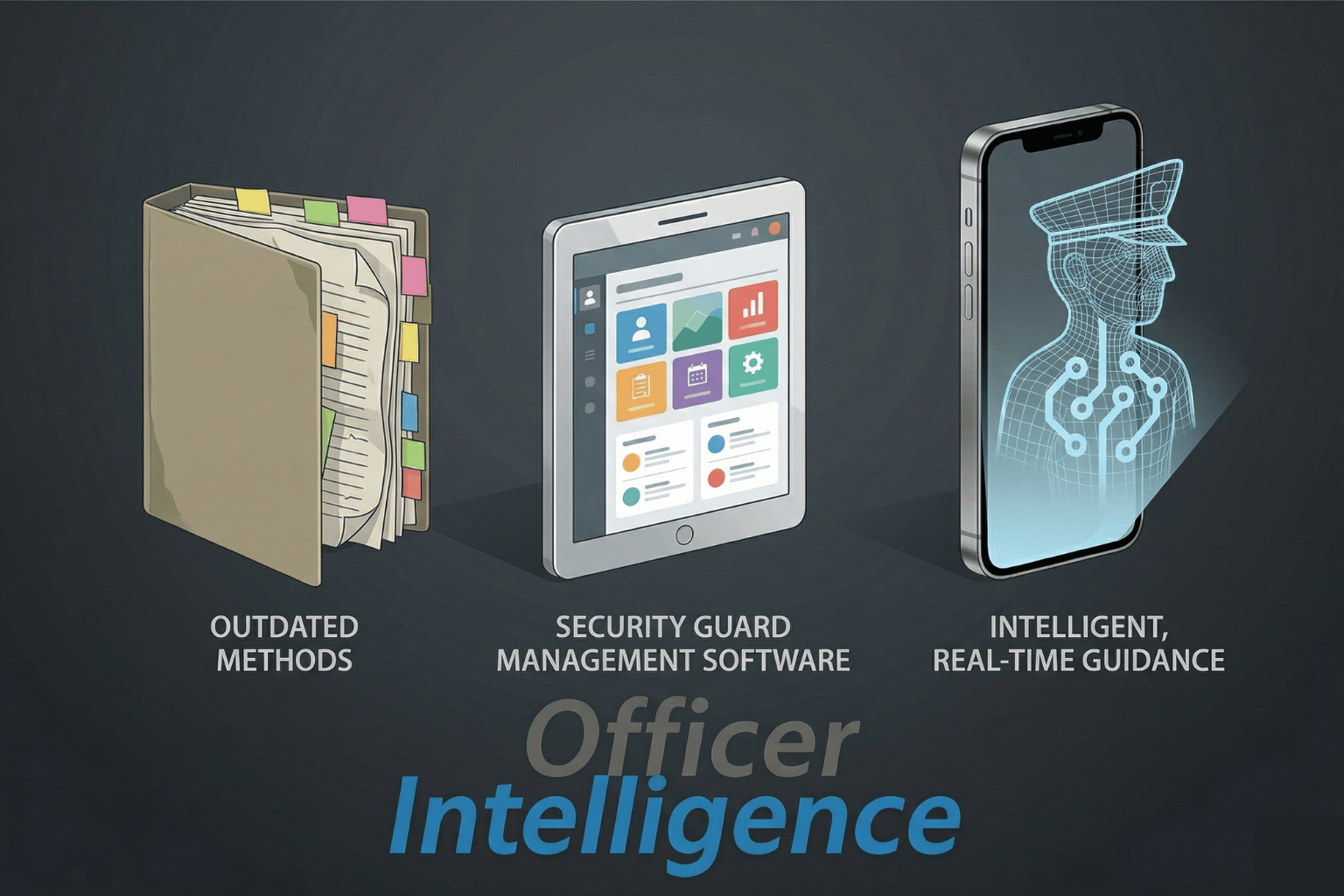
What has been missing is a practical way to bridge the gap between written procedures and real-time application. But advances in AI are beginning to provide that bridge. Instead of requiring officers to locate and interpret information on their own, AI allows them to ask direct questions to their security guard management software and receive answers based on the actual post orders for their site.
This approach changes the role of post orders. They are no longer limited to onboarding materials or compliance documents. They become part of daily operations, supporting officers as situations develop.
Introducing Post Order Agent
This is the thinking behind OfficerReports, Post Order Agent, part of the OfficerIntelligence suite. The objective is straightforward. Take the security company post orders you already have and make them usable in real time.
An officer can ask how to respond to a specific situation, whether that situation involves granting access to a visitor or what steps to take during an emergency. The system interprets the question, references the relevant post orders, and provides a clear response based on that guidance.
In practical terms, it functions like having a supervisor available at all times. It reinforces the intent behind your security company’s post orders and helps ensure that decisions are consistent across your operation.
This does not replace training or experience. It supports them by reducing uncertainty and providing clarity when it matters most.
Why This Matters for Security Guard Company Owners
For owners, improving how security guard company post orders are used has both operational and strategic implications. From an operational standpoint, clearer and more accessible guidance leads to more consistent execution. This reduces the likelihood of incidents driven by misinterpretation and helps maintain service quality across sites and teams.
From a strategic perspective, clients increasingly expect not just documented procedures but proof that those procedures are being followed. The ability to demonstrate that your officers are supported by systems that reinforce decision-making can strengthen trust and differentiate your company in a competitive market.
While it is still early to quantify the full impact of AI-driven tools across the industry, it is reasonable to expect that companies that make their post orders more usable will be better positioned than those that rely solely on static documentation.
Rethinking Security Guard Company Post Orders
Security guard company post orders are not going away, nor should they. They remain a critical part of how service is defined and delivered. What is changing is how they can be used.
Instead of functioning primarily as reference materials, post orders can become systems that actively support decision-making in real time. That shift addresses a long-standing gap between written procedures and real-world execution.
The question is no longer whether your company has post orders in place. It is whether those post orders are truly usable when your officers need them most.
If you want to see how Post Order Agent can make your security guard company post orders searchable and dynamic, you can learn more and request more information here.

By Courtney Sparkman
 Courtney is the founder and CEO of OfficerApps.com, a security guard company software provider, specializing in security guard management software, and publisher of Security Guard Services Magazine. He is a renowned author and security industry syndicator who also hosts an active YouTube channel, helping thousands of his subscribers to grow their security guard services companies.