

Most security company owners have experienced an all to familiar pattern. A request for proposal (RFP) is received, a proposal is submitted, the relationship feels solid, and then the conversation shifts. The prospect starts referencing another quote, and before long, the buyer’s decision comes down to the lowest bid for the security contract.
It is easy to interpret this situation as a pricing issue with the proposal, or assume the buyer is simply focused on cost. But in most cases, the billing rate is not the root problem. The conversation’s degeneration into pricing is the result of something deeper. It reflects how the service is being understood and, more importantly, how difficult it is for the buyer to see meaningful differences between the various providers.
When viewed this way, commoditization is not just a sales problem. It is a business problem that shows up during the sales process.
Commoditization Does Not Start in Sales
When I say commoditization, I am referring to the process by which a product or service is perceived as interchangeable with others, making it difficult for buyers to distinguish meaningful differences among providers. Think of copy paper, pencils, or oil change shops as prime examples of commoditized products and services. Many security companies try to solve the commoditization problem by improving their sales approach. They refine presentations, adjust messaging, and train their teams to better communicate value. While these efforts can help some, they rarely address the underlying issue.
Commoditization begins with how the business is structured and how its value is expressed through operations. If two companies deliver services or communicate results in similar ways, it becomes difficult for a buyer to distinguish between them. Even if one company is objectively stronger, that difference is not always visible.
Sales does not create differentiation in a commoditized market, it exposes it. If the underlying operation does not produce clear, observable differences, the sales process will eventually flatten those differences into a price comparison.
What Commoditization Does to a Security Company
Once a company is pulled into competing on the lowest bid for security contracts, the effects tend to compound over time.
Margins tighten first. This is often seen as a manageable trade-off to win business, but it has downstream consequences. Lower margins reduce the company’s ability to invest in areas that drive long-term performance, such as training, supervision, and technology. Those investments are often what create separation in the first place.
As those constraints take hold, the operation becomes more reactive. Supervisors have less time, systems get stretched, and consistency becomes harder to maintain across sites. None of this happens overnight, but the cumulative effect is noticeable.
Over time, the company that fought against commoditization begins to resemble the very competitors it is trying to differentiate itself from. At that point, the market’s perception of sameness is no longer just a communication issue, it is operationally reinforced.
Why the Cycle Is Difficult to Escape
The challenge with commoditization is not just that it reduces pricing power. It is that it creates a cycle that is difficult to break.
Winning contracts at lower margins limits a company’s ability to invest. That lack of investment makes it harder to improve the service in ways that are visible to the client. Without visible improvement, the company remains difficult to distinguish. That leads to continued pressure to compete on the lowest bid for security contracts.
Many companies find themselves caught in this loop without intentionally choosing it. Each decision to reduce pricing may make sense in the moment to win the contract, but over time, those decisions shape the structure of the business.
Breaking out of that cycle requires a deliberate shift in how the company creates and demonstrates value.
Why Buyers Choose the Lowest Bid
From the buyer’s perspective, choosing the lowest bid is often a rational decision. If multiple proposals appear to offer the same outcome, paying more introduces unnecessary risk. Without clear evidence of a difference, the lowest price becomes the most defensible choice.
This is especially true in environments where procurement teams or financial stakeholders are involved. In those cases, decisions are often scrutinized, and selecting a higher-priced option without a clear justification can be difficult to support.
The key point is that buyers are not necessarily trying to reduce quality. They are responding to the information available to them. If the differences between providers are not clear, the decision defaults to cost.
The Work Required to Break Out of Being the Lowest Bid
Moving away from competing on the lowest bid for security contracts requires more than stronger messaging. It requires building a business that produces differentiation in a way the client can see and understand.
This often starts with how performance is measured and communicated. If the client cannot clearly see what is happening across their sites, it becomes difficult for them to appreciate the quality of the service. Visibility creates context, and context allows for better evaluation.
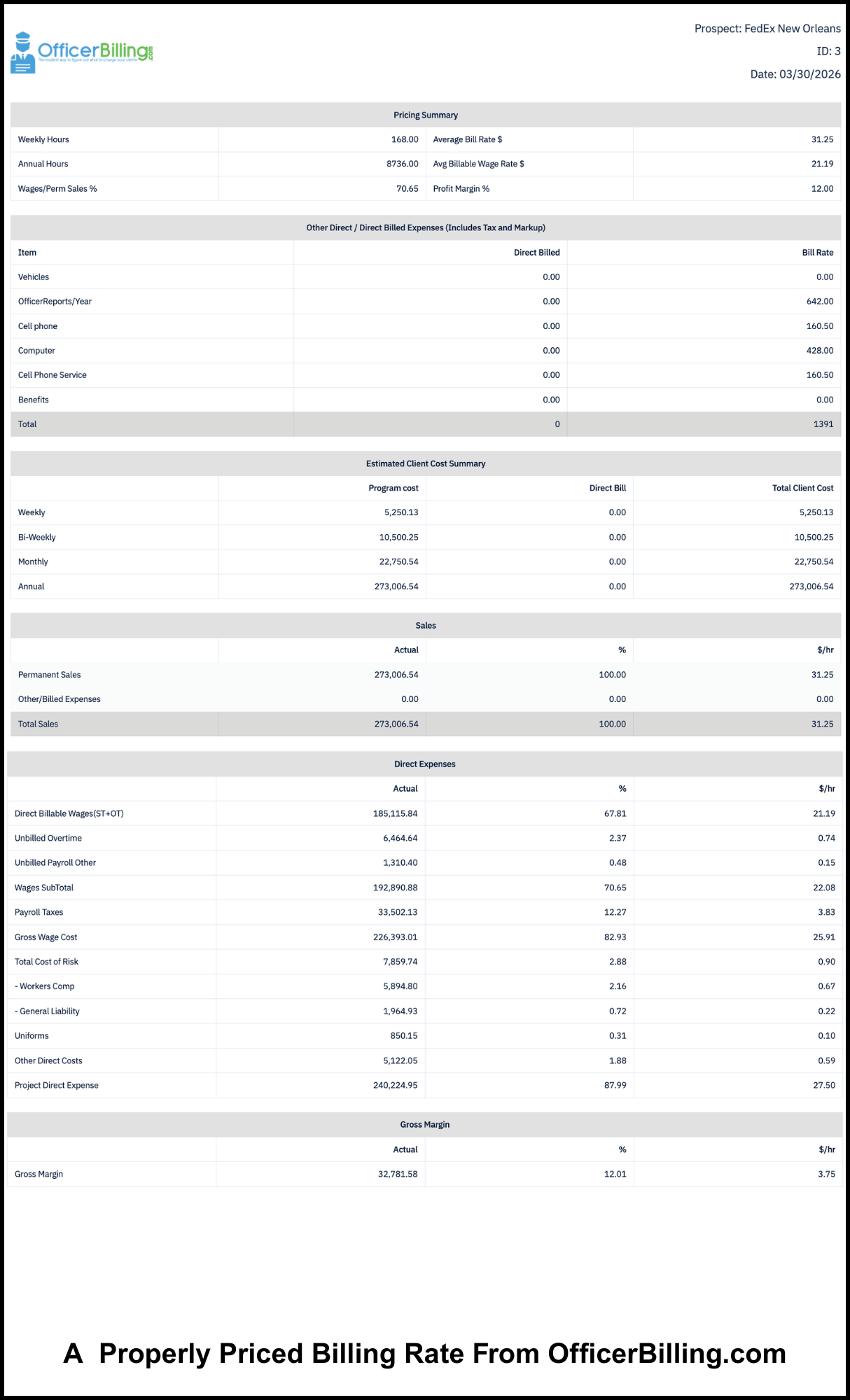
Just as important is the ability to clearly explain how your service is priced and what that pricing supports. Many proposals present a final number without much context, which makes it easy for buyers to compare providers based on price alone. When pricing is treated as a single figure, it reinforces the perception that all services are essentially the same.
A more effective approach is to walk the buyer through how that number is built. When you can explain wages, payroll burden, supervision, insurance, and the systems required to support the operation, the conversation begins to shift. The price becomes a reflection of the service model, not just a number at the bottom of the page.
The above example from OfficerBilling.com illustrates what a structured pricing model can look like. It shows how different cost components contribute to the final bill rate and provides a clearer picture of what is required to deliver consistent service.
When buyers understand this, pricing discussions change. Lowering the bill rate is no longer an abstract request. It becomes a decision to reduce something specific, whether that is officer pay, supervision, training, or overall program support. In many cases, that clarity reduces pressure to simply match the lowest bid, because the tradeoffs are visible.
Consistency is another critical factor. A company that delivers predictable, repeatable performance across locations begins to stand out over time. This is not achieved through isolated effort, but through systems and processes that support the operation at scale.
Finally, there is the question of how information flows. Companies that can capture, organize, and communicate meaningful data about their operations are better positioned to demonstrate value. This does not require complex analytics. It requires clarity and relevance.
Aligning Sales With Operations
Once the operation begins to produce clear signals of differentiation, the role of sales changes. Instead of trying to create perceived value through messaging alone, the sales process becomes a way to translate operational reality into something the buyer can understand.
This alignment is where many companies begin to set themselves apart. Sales, operations, and marketing are no longer working independently. They reinforce each other, creating a more coherent picture for the client.
When that happens, conversations around pricing tend to become more balanced. The lowest bid still exists, but it is no longer the only factor driving conversations between you and the buyer.
A More Durable Path Beyond Being the Lowest Bid for Security Contracts
There will always be situations where the lowest bid for security contracts wins. That is part of the market and not something that can be eliminated entirely.
The goal is not to avoid those opportunities, but to avoid building a business that depends on them. Companies that operate primarily on price often find themselves under constant pressure, with limited ability to invest or evolve.
In contrast, companies that focus on creating visible, operational differentiation tend to build more stable and resilient businesses. They are better positioned to maintain margins, invest in their teams, and develop long-term client relationships.
Final Thought
The lowest bid for security contracts is often treated as the problem. In reality, it is a signal. It reflects how clearly a company’s value can be seen and understood by the buyer.
For security company owners, this article frames a different way of thinking about the issue. The question is no longer just how to win more deals, but how to build a business that is difficult to compare in the first place.
When that happens, price does not disappear from the conversation. It simply stops being the only thing that matters.
By Courtney Sparkman

 Courtney is the founder and CEO of OfficerApps.com, a security guard company software provider, specializing in security guard management software, and publisher of Security Guard Services Magazine. He is a renowned author and security industry syndicator who also hosts an active YouTube channel, helping thousands of his subscribers to grow their security guard services companies.








One reply on “Why the Lowest Bid for Security Contracts Is Not About Price”
It’s really interesting to hear about how experience and proper planning factor in. I’ve definitely seen companies prioritize saving a little upfront and then end up with major headaches later on.