Over the past five to six years, the security industry has seen more innovation in security guard technology than in the previous twenty. Artificial intelligence, robotics, automation, and powerful software tools have completely reshaped what is possible in delivering safety and efficiency.
Yet despite all of this progress, I still find myself asking: are security guard companies ready to sell value, or are they still competing to be the lowest bidder?
Unfortunately, I would say that too often, the focus remains on underbidding rather than outsmarting. And as larger firms continue to embrace technology to differentiate their services, smaller and mid-sized companies risk being left behind.
The Old Model: Competing on Price
For decades, many security companies have relied on a simple formula: win contracts by offering the lowest hourly rate. While that approach might win short-term business, it is not a sustainable strategy in a world where clients expect data, accountability, and measurable results.
Clients today want to see proof of performance, not just people on posts. They want trackable training, transparent reporting, faster response times, and clear evidence that their investment in security is paying off.
Technology provides those answers. But too many companies are still trying to compete by selling warm bodies rather than solutions.
The New Model: Selling Value Through Security Guard Technology
The best-performing companies I know, regardless of size, share a common thread: they have learned how to merge technology with their manned guard services.
They do not just fill posts. They build programs.
That means offering clients:
-
Trackable training programs that verify officers are properly prepared for each site
-
Security guard management software that improves communication and transparency between the field and the client
-
Integrated reporting tools that give clients instant visibility into what is happening across their properties.
By doing these things, they stop selling hours and start selling outcomes.
These companies understand that when you embed technology into your services, you do not just improve efficiency, you also increase the value of your offering. And when you sell value, you can justify higher billing rates and healthier margins.

Complementary Technologies: Expanding Beyond Manned Guarding
Embracing technology is not only about improving what you already do, but also about expanding into new opportunities and reducing risk for your officers.
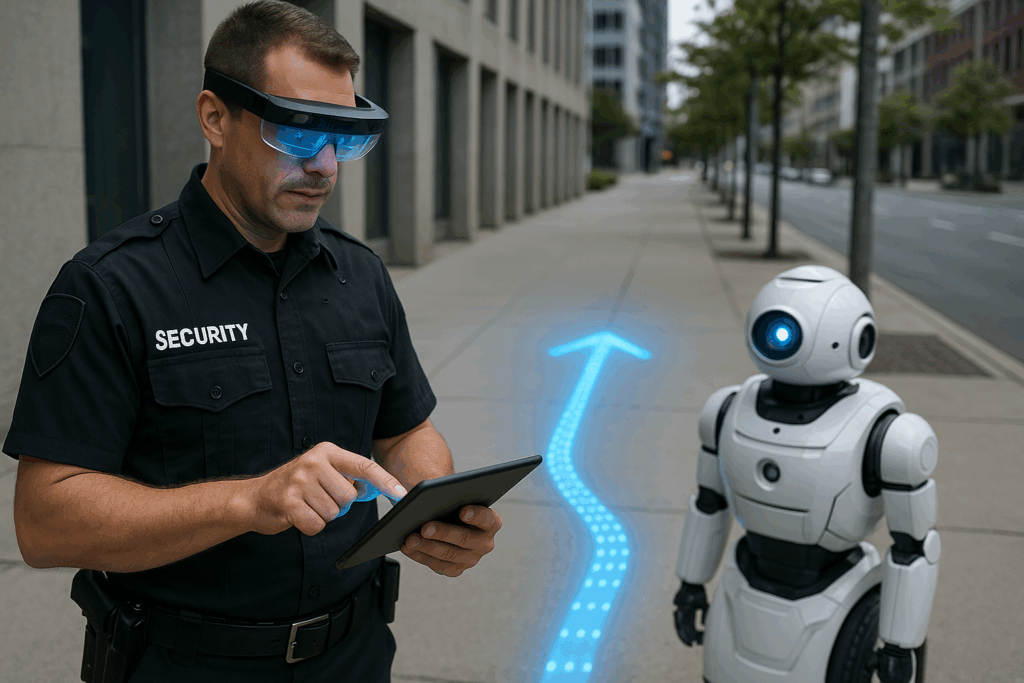
Take robotics and AI-assisted devices, for example. Companies like Knightscope and Robotic Assistance Devices (RAD) are introducing solutions that can patrol perimeters, capture video, detect anomalies, and provide data-driven insights at a fraction of the cost of a human officer.
That affordability creates new possibilities for security programs that previously could not justify a larger staff. A property that cannot afford to post two officers overnight might be able to pair one officer with a robot. The robot can handle routine patrols and monitor high-risk areas, while the officer focuses on customer interaction, decision-making, and response. The client receives a higher level of coverage at a manageable price, and the security company delivers more value without simply cutting rates.
Equally important, robotics and AI reduce the physical risk to human officers. There are many situations where it is safer to send a robot to investigate before sending a person. For example, rather than dispatching an officer alone at two in the morning to check out a suspicious noise or possible break-in, the robot can go first, transmit live video, and allow the officer to make an informed decision about how to respond.
This kind of integration does not replace people. It protects them. It extends their reach, enhances their effectiveness, and allows security companies to deliver better results while keeping their officers safe.
Forward-thinking companies are already positioning themselves as integrators of these technologies, offering flexible programs that combine manpower, robotics, and AI-driven insight. They are not afraid of change…they are leading it.
Why Many Companies Still Resist Change
So why are more security companies not adopting technology?
In my experience, it comes down to fear of change and/or fear of technology.
Believe me, I understand, learning new systems can feel uncomfortable and absolutely frightening. Many owners built their companies by doing things a certain way for decades, and the idea of switching to a tech-driven model feels risky, at a minimum. I’m sure many wonder, if the technology doesn’t pan out, how does that affect my business? Will I lose my customer? or worse…
But here is the truth: the greater risk is doing nothing.
While smaller companies hesitate, larger firms are already investing in AI, analytics, and automation to set themselves apart. They are showing clients exactly how technology enhances coverage, improves response times, and reduces liability — and they are charging accordingly.
The companies that cling to the old ways of doing business are finding it harder and harder to compete, and it will only get worse.
From Billing Rate to Problem Solving
One of the biggest mindset shifts security companies need to make is worrying less about billing rate and more about problem-solving.
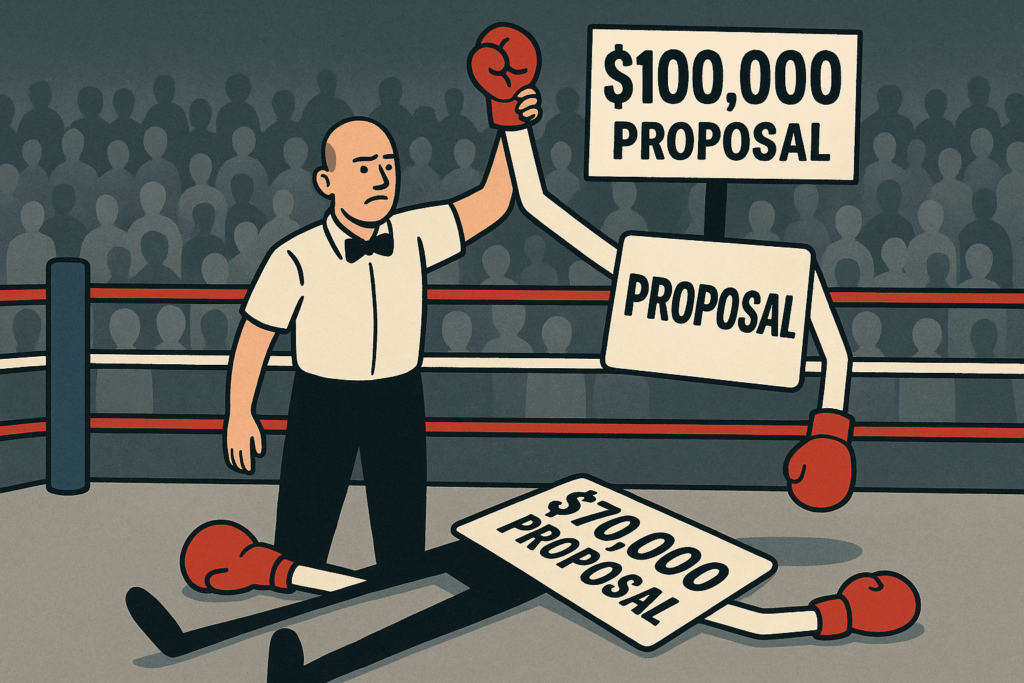
When I talk with clients, whether property managers, corporate security directors, or municipalities, I have seen them choose a more expensive vendor over the lowest-priced one on numerous occasions. Why? Because the higher-priced company offered a creative, value-driven solution that solved their problem.
For example, I spoke with a security company that had developed significant expertise in access control. During a site walk-through for a new bid, they started talking with the prospect about how updating the access control system could actually reduce their ongoing security guard costs. That conversation shifted everything. Even though access control was technically outside the original scope of work and drastically increased the bid, they built it into their proposal, and that creative approach helped them win the contract.
That is the power of selling outcomes instead of hours.
When you show clients how your technology reduces risk, increases visibility, and helps them operate more safely and efficiently, you stop being just another vendor; you become a strategic partner.
What the Future of Security Guard Technology Looks Like
The next generation of security companies will be defined by how effectively they blend people, processes, and technology.
A modern, tech-enabled company does not have to be futuristic or complicated. It just needs to use the tools available, artificial intelligence, reporting automation, guard management platforms, robotics, and analytics, to improve performance and transparency.
The companies that thrive will be the ones that:
-
Use technology to make their teams more effective
-
Provide clients with real-time visibility and measurable results
-
Offer creative, data-driven solutions that solve problems instead of simply filling posts
That is the kind of company clients will stay with and pay for.
The Bottom Line
The security industry is evolving, whether we like it or not.
The future is not about replacing people; it is about empowering them with better tools and expanding what is possible through innovation.
Security guard companies that embrace technology, from security guard management software to artificial intelligence to robotics, are positioning themselves not just to survive but to lead.
Because in this new era, the future of security is not cheaper.
It is smarter.
Have you embraced security guard technology within your company? If so, I’d love to hear about it below.
.
.
By Courtney Sparkman
 Courtney is the founder and CEO of OfficerApps.com, a security guard company software provider and publisher of Security Guard Services Magazine. He is a renowned author and security industry syndicator who also hosts an active YouTube channel, helping thousands of his subscribers to grow their security guard companies.