The security industry needs innovation, and it is good to see more technology companies paying attention to the problems security guard companies deal with every day. But those innovations cannot create liability for those same security guard companies. For years, many operators have been forced to manage complex field operations with tools that were too disconnected, too limited, or clearly built by people who did not understand the business. Artificial intelligence may become one of the most important advances the industry has seen, especially if it helps owners, managers, and supervisors professionalize security reports while still enabling them to understand what is happening across their operations in a more practical way.
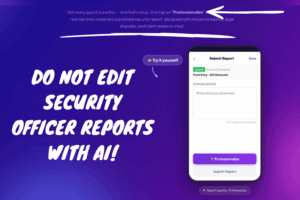
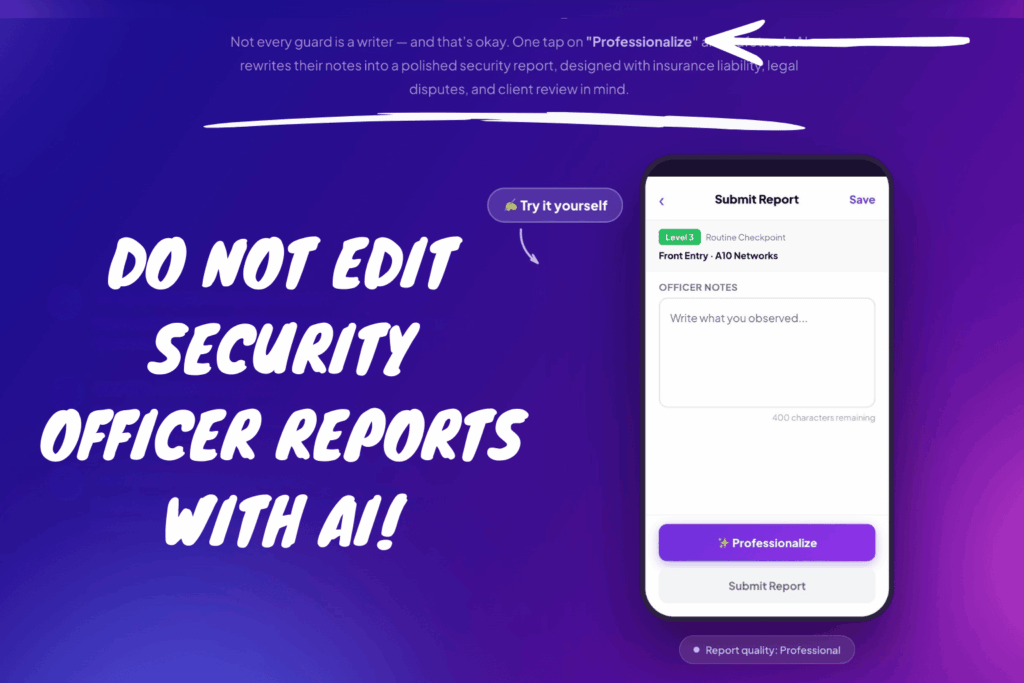
But innovation does not remove responsibility, especially when it touches security officer reports. As AI security guard software becomes more common, more companies will enter the security guard software space with promises to professionalize security reports by rewriting, polishing, or improving what officers submit. At first glance, that may sound useful. Not every officer is a strong writer, and every security company has dealt with reports that are too informal, too vague, poorly structured, or filled with grammar and spelling issues. The problem is that a security officer’s report is not just another piece of business writing.
A security officer’s report is a business record. It is often a client communication. In some situations, it may become part of an insurance claim, a legal dispute, an internal investigation, or a larger review of what happened at a site. Once that is understood, the conversation around using AI to professionalize security reports changes. The question is no longer whether AI can make a report sound better. The question is whether AI should be changing the officer’s original account at all.
The Goal Should Be to Professionalize Security Reports, Not Rewrite Them
Security companies have always struggled with report quality. Any owner or manager who has reviewed daily activity reports, incident reports, or shift notes understands the issue. Some officers write too little and leave out important context. Others write too much without clearly explaining what happened. Some use language that creates confusion, while others fail to separate what they observed from what they assumed.
That is a real operational problem, and it should not be ignored. Poor reporting can damage client confidence, weaken supervision, and make it harder for management to understand what is happening in the field. Security companies should absolutely want to professionalize security reports, but the solution cannot be to allow artificial intelligence to rewrite the officer’s version of events in a way that changes the language, tone, judgment, or meaning of the original report.
There is a major difference between helping an officer prepare a clearer report and changing a report after the officer has documented what they observed. That difference matters because the report should reflect what the officer saw, heard, did, and understood at the time. A report does not become more reliable simply because it sounds more polished. In some cases, making it sound more polished may actually create new risk.
Rewriting Can Change the Meaning of a Security Report
Small wording changes can create significant problems in security reporting. An officer may write, “I saw a man walking near the west gate.” An AI system may rewrite that as, “A suspicious individual was observed near the west gate.” The second sentence may sound more formal, but it is not the same statement. The officer described a person walking near a gate. The rewritten version introduces suspicion, which is a judgment the officer may not have made.
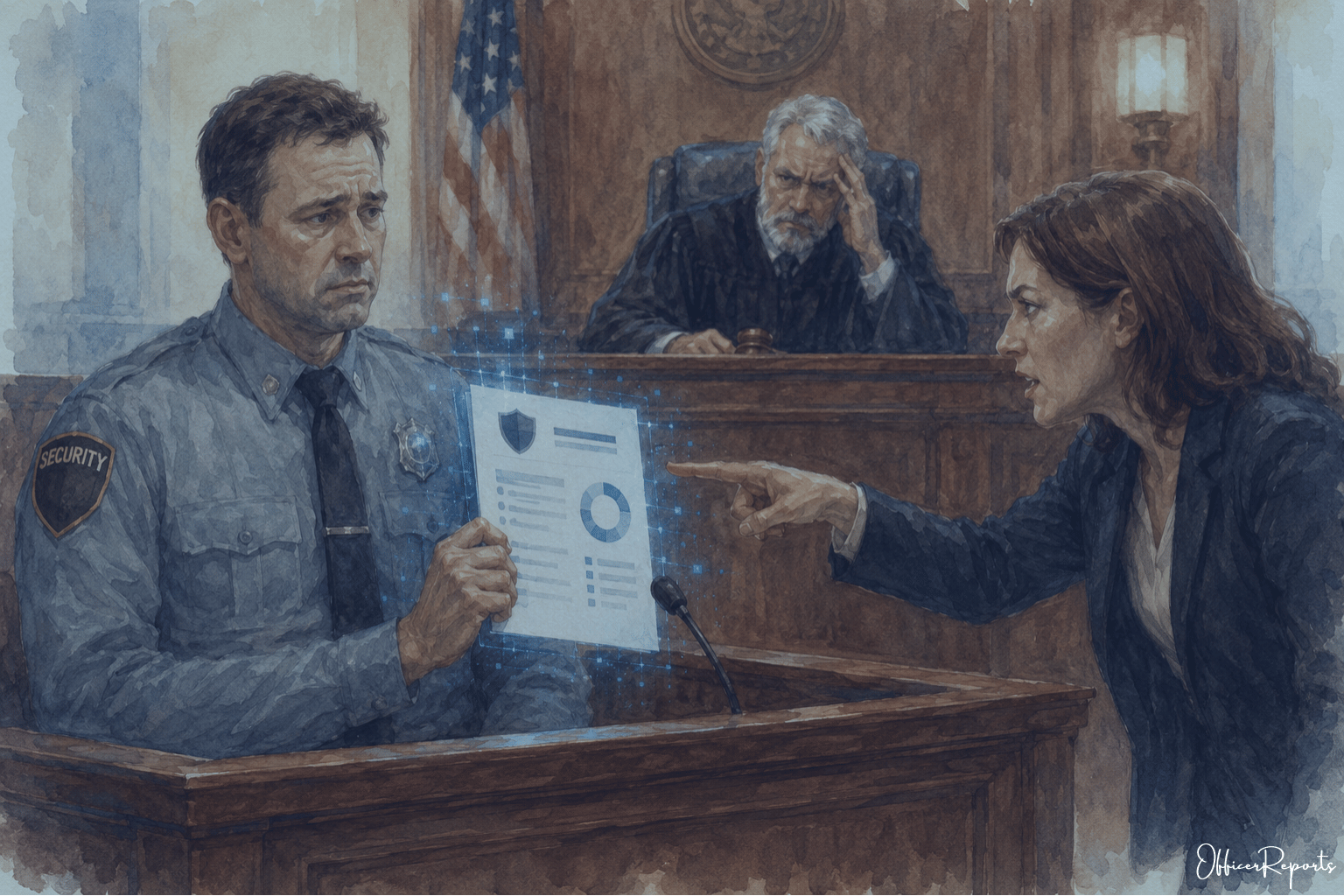
That may seem minor in a software demonstration, but it may not seem minor when the report is reviewed by a client, an attorney, an insurance carrier, or someone investigating an incident. In court, that small change in statement opens the security company and the client to liability. The issue is not whether the sentence sounds better. The issue is whether the revised version still accurately reflects what the officer actually documented. Once AI begins to change words, add context, or improve tone, the company must consider whether the original record is still preserved.
This is why security officer reports must be treated differently from ordinary business content. A sales email can be rewritten. A marketing paragraph can be improved. A proposal can be polished. A report tied to a real event, a real location, and a real point in time requires a different standard because the integrity of the original account matters.
AI Can Help Professionalize Security Reports When It Stays in the Right Lane
None of this means AI has no place in security guard operations. In fact, AI can be extremely valuable when it is used to help companies better understand their operations. It can help supervisors identify reports that appear incomplete, flag missing information, summarize trends, recognize recurring issues, and give owners better visibility into activity across sites, shifts, officers, and clients.
Those use cases matter because most security companies already have more operational information than they can reasonably review by hand. Reports, clock ins, GPS activity, patrol records, incident logs, missed checkpoints, late arrivals, and supervisor notes all contain signals about the health of the operation. The problem is that this information is often scattered across systems and too time consuming for managers to analyze consistently.
This is where AI can help professionalize security reports in a responsible way, but the distinction has to be clear. There is a difference between analyzing a report and rewriting the report. There is a difference between helping a supervisor understand what is happening and changing the officer’s original account. There is also a difference between using AI to create intelligence from operational data and using AI to alter records that may later be questioned.
The Security Industry Will See a Lot of AI Visitors
As AI becomes more popular, more companies will enter the security space because they see opportunity. Some will bring impressive technology. Some will bring polished marketing. Some will bring clean interfaces and confident claims about transforming officer reports with a single tap. The technology may look impressive, but technology alone is not the same as understanding the security business.
Security guard companies are not simply managing tasks. They are managing liability, client expectations, officer performance, contract retention, payroll pressure, supervision gaps, post order compliance, incident documentation, and legal exposure. Those realities shape how software should be built and where AI should be allowed to operate.
A company that does not understand the business may look at officer reports and see a writing problem. An operator looks at officer reports and sees something much more important. They see a legal record, a client communication tool, a supervision mechanism, and a possible document that may have to stand up to scrutiny later. That difference in perspective matters because the wrong approach to AI may appear innovative while quietly creating risk for the security company.
OfficerApps Was Built From the Operator’s Perspective
This is one of the key differences between OfficerApps and many AI security guard software companies. We are not visitors to this industry, and we do not look at officer reports as ordinary text that simply needs to sound more professional. We understand what it means when a client questions a report, when a supervisor has to defend what happened on a post, and when an officer’s documentation becomes part of a larger issue.
That operator perspective changes how AI should be used. The goal should not be to make every officer sound like a professional writer. The goal should be to preserve the integrity of the officer’s record while helping the company manage quality, consistency, supervision, and visibility around that record. Those are very different objectives, and confusing them can create consequences that may not become obvious until the report is challenged.
Security companies need better reporting, but better reporting does not mean artificially rewriting what an officer said. Better reporting means helping officers capture the right information, helping supervisors review the right reports, and helping owners understand what the reports reveal about their operation. That is a more responsible and more useful way to professionalize security reports.
The Real Opportunity for AI in Security Guard Companies
The future of AI in security should not be centered on making officer reports sound like they were written by someone else. The real opportunity is much bigger than that. AI should help security company owners understand their operations at scale, identify risk before it becomes a client complaint, and recognize patterns across posts, officers, shifts, reports, incidents, and clients.
This is where the industry needs help. Many security companies have valuable information flowing through their operations every day, but they do not have enough time, management capacity, or supervisory coverage to turn that information into insight. AI can help close that gap by surfacing the issues that need attention, highlighting trends that may otherwise be missed, and helping managers make better decisions with the information they already have.
That is a very different use of AI than rewriting a report. One approach helps the company understand the truth more clearly. The other risks changing the original record in pursuit of cleaner language. Security companies should be very careful not to confuse those two ideas.
Final Thought
I will change the security guard industry, and that change should be welcomed when it helps operators build stronger, more visible, and more accountable businesses. But the use of AI has to be guided by the realities of the industry, not just by what the technology is capable of doing.
That is the approach we are taking with OfficerIntelligence. We are using AI to help security companies transform operational data into practical intelligence without rewriting the officer’s original record. The Daily Security Brief helps turn daily activity into a clearer operational summary…without changing the officer’s original report. Post Order Agent helps companies make post orders easier to access, understand, and use in the field. Our upcoming Supervisor Agent is being built to help owners and managers identify coaching opportunities, recognize performance patterns, and improve supervision at scale.
That is where we believe AI belongs in the security industry. It should help operators see what is happening, understand what needs attention, and make better decisions without changing the truth of what was documented.
If you would like to learn more about how OfficerIntelligence, the Daily Security Brief, Post Order Agent, or the upcoming Supervisor Agent can help your security company improve operations, reporting visibility, and supervision, reach out to us.