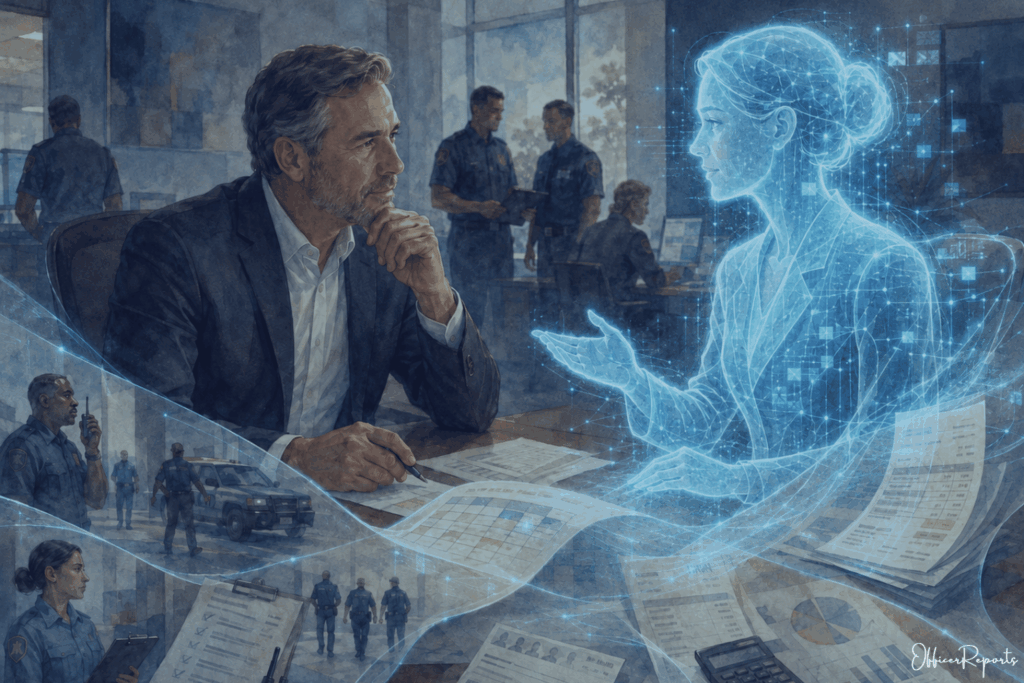
If you could hire one more employee tomorrow, who would it be? Most security company owners would probably choose another recruiter, scheduler, supervisor, operations manager, or salesperson. Every one of those answers would make sense. But when I think about the most valuable use of AI for security companies, my answer would be different. I would hire someone whose sole responsibility was to understand the entire business and help leadership make better decisions.
This person would study operations, payroll, accounting, customer activity, employee performance, and financial trends. Every morning, that person would tell me what had changed, what required my attention, and which problems were beginning to form before they became expensive.
Most small and mid-sized security companies have never been able to afford an employee like that. The role would require a combination of operational knowledge, financial understanding, analytical ability, and constant access to information from across the organization. AI changes that.
The first AI employee a security company should “hire” is not a chatbot, a report writer, a recruiter, or a scheduler. It is an executive business analyst.
The greatest value of AI is not replacing work. It is helping leaders understand their businesses well enough to make better decisions.
AI for Security Companies Should Answer the Questions Nobody Has Time to Research
Security company owners rarely suffer from a shortage of questions. They suffer from a shortage of time and organized information.
Which clients deserve my attention today? Where is overtime beginning to rise? Which supervisors are overloaded? Which officers are improving? Which customers require so much management attention that they may no longer be profitable? Which branch is becoming unstable? Where are service problems beginning to repeat themselves?
These are not software questions. They are executive questions.
The answers usually exist somewhere inside the company, but they are scattered across reports, schedules, payroll records, accounting systems, emails, text messages, incident logs, customer complaints, and the experience of individual managers.
Finding an answer often requires someone to gather information from several sources, compare it manually, ask others for context, and decide whether the pattern is meaningful. By the time that process is complete, the owner may have moved on to three other problems.
This is why so many security companies are managed through urgency. Leaders spend their days responding to whichever problem is most visible rather than examining which problem is most important.
A good business analyst changes that dynamic. The analyst does not eliminate leadership judgment. The analyst gives leadership a clearer picture on which to base that judgment.
Every Software System Knows Something About the Business
Every system inside a security company sees one part of the operation.
A security guard management platform such as OfficerReports may know what is happening operationally. It can see incident reports, daily activity reports, patrol activity, attendance, GPS information, post-order compliance, client sites, and patterns in officer performance.
A payroll or human resources platform sees a different picture. It may know wages, overtime, employee tenure, turnover, paid time off, absenteeism, recruiting activity, and the labor costs associated with individual officers or branches.
QuickBooks sees another part of the company. It understands invoices, collections, expenses, customer balances, margins, cash flow, and whether the company is being paid for the work it has already performed.
Each system is valuable because it performs its assigned job. The problem is that each one operates within its own walls.
The reporting system may know that one customer generates twice as many field supervisor visits as comparable accounts, but it may not know what the company earns on that contract. Payroll may know that a particular site produces excessive overtime, but it may not know whether the overtime is being caused by call-offs, scheduling practices, turnover, or an unusually difficult client. Accounting may show that a customer’s margin is declining, but it may not explain what is happening operationally that is causing the decline.
Every system tells part of the story. None understands the entire business by itself.
The Best Uses of AI for Security Companies Span Multiple Systems
Executives do not usually wake up wanting to run a payroll report or inspect a dashboard. They wake up wanting answers to business questions:
- Which clients are becoming less profitable?
- Which branches deserve another supervisor?
- Why has overtime increased?
- Which customers require the most management attention?
- Which supervisors are carrying the most difficult portfolio?
- Which customers should sales avoid pursuing again?
None of these questions can be answered reliably in a single application.
Consider a customer whose profitability has been declining for three months. QuickBooks might reveal that the margin is shrinking, but it cannot explain why. Payroll may show that overtime at the account has increased, while the scheduling system reveals that open shifts have become more common. Operational records may show a rise in incidents, complaints, and supervisor visits. Human resources data may reveal that the site has unusually high officer turnover.
Individually, those facts look like separate problems. Together, they tell a more useful story: the account may be underpriced, poorly staffed, operationally demanding, or all three. That is business intelligence.
The same principle applies when deciding whether to add a supervisor. The decision should not be based solely on how many officers a branch employs. Leadership should consider the number and complexity of sites, travel requirements, incident volume, call-offs, turnover, client complaints, report quality, open shifts, and the amount of time the existing supervisor spends resolving problems.
A manager may appear inefficient when viewed through one system. When the information is combined, it may become clear that the manager has simply been assigned the most difficult portfolio in the company.
This is why the future of AI for security companies cannot be limited to isolated features. An AI tool that only reads reports may summarize reports well, but it cannot explain what those reports mean financially. An AI tool connected only to accounting may identify a margin problem, but it cannot explain the operational conditions causing it.
The questions that matter most live between systems.
AI for Security Companies Is Only as Useful as Its Context
One of the biggest misconceptions about artificial intelligence is that better answers come primarily from choosing a more advanced AI model.
The model matters, but context matters more.
A generic AI system does not know your customers, officers, supervisors, margins, contracts, schedules, payroll, post orders, or operational history. It does not know that a particular client complains every Friday, that one branch has lost three experienced officers, or that a contract which appears profitable requires an unusual amount of uncompensated management time.
Without access to the company’s actual information, AI can only provide generic advice. It may offer useful ideas, but it cannot explain what is happening inside a specific business.
Once AI is securely connected to relevant business data, its role changes. It can begin identifying relationships, comparing trends, and helping leadership examine questions that would otherwise require hours of manual research.
For example, it might discover that overtime is rising at accounts with the highest turnover. It might show that a group of customers with similar billing rates require dramatically different levels of supervision. It might identify officers whose attendance, report quality, and client feedback have all improved over the past 90 days. It might reveal that slow paying clients also generate a disproportionate number of operational complaints.
The AI is not creating those facts. It is helping management see connections that already exist.
That distinction matters. Artificial intelligence for security operations should not be treated as an all-knowing authority. It should be treated as an analytical layer that organizes information, surfaces patterns, and helps leaders ask better questions.
Connected Data Makes AI for Security Companies More Valuable
This is where Connect changes the conversation. Connect is the next evolution of OfficerReports AI security guard software.
Connect is the integration layer that allows AI to securely access information from OfficerReports, QuickBooks, payroll platforms, and other business systems.
The interesting part of Connect is not simply that it allows different software systems to exchange information. Traditional integrations have been doing that for years.
The greater opportunity lies in enabling an AI business analyst to understand relationships among operational, financial, payroll, and workforce data.
Instead of seeing operations or payroll or accounting, the AI begins to see how those parts of the company affect one another.
That difference is important because businesses do not operate in separate software categories. A recruiting problem eventually becomes a scheduling problem. A scheduling problem can become an overtime problem. An overtime problem can reduce the profitability of a contract. A profitability problem may lead to weaker supervision, delayed investment, or pressure to raise prices.
The systems may record those events separately, but the owner experiences them as one interconnected business problem.
The long-term value of connected AI for security companies lies in its ability to examine the entire chain. It gives leaders an opportunity to move beyond knowing what happened and begin understanding why it happened.
That is the difference between data and intelligence!
Imagine Starting Every Morning With an AI Business Briefing
Imagine opening your laptop each morning and asking one question:
What happened yesterday that deserves my attention?
The response would not be a generic summary of every activity in the company. It would identify the few items that appear most important.
- A major customer experienced an unusual increase in incidents.
- Overtime at two accounts has risen for three consecutive weeks.
- One branch has a growing number of open shifts.
- A supervisor’s portfolio is producing twice as many escalations as comparable portfolios.
- One officer’s attendance, report quality, and client feedback have improved significantly.
- A profitable customer has started paying invoices more slowly.
From there, leadership could ask follow-up questions.
- Which client is becoming operationally unstable?
- Where are margins beginning to shrink?
- Which supervisor needs additional support?
- Which customers should we consider raising prices on?
- Which contracts require more management time than their margins justify?
- What patterns should I know about before my first meeting?
This does not require AI to make the final decision. It requires AI to assemble the relevant information quickly enough for a human being to make a more informed decision.
That is the direction executive decision-making is heading. Leaders will spend less time searching for information and more time evaluating what the information means.
AI for Security Companies Should Make Managers and Supervisors Better
The same approach can improve management below the executive level.
A supervisor does not need AI to replace conversations with officers, conduct site inspections, manage client relationships, or exercise judgment in the field. The supervisor needs help understanding where to focus their limited time.
Instead of reviewing every report manually, the supervisor might receive a summary of recurring issues, declining report quality, incomplete patrols, repeated late arrivals, or officers who appear to need additional coaching. The system might also recognize improvement and identify officers who deserve positive feedback.
This supports the idea that the future of security supervision is continuous rather than annual. Coaching becomes more useful when it is based on recent patterns instead of a manager’s memory of isolated events.
AI security guard software should make managers more observant, not less involved. It should help them enter conversations with better information and a clearer understanding of what has changed.
The quality of supervision still depends on the manager. AI simply helps the manager see more of the operation.
AI Does Not Replace Security Company Leadership
There is a natural tendency to discuss AI in terms of jobs it might eliminate. That framing is especially unhelpful in the security industry, where judgment, relationships, leadership, and physical presence remain essential.
AI should not replace supervisors, operations managers, executives, recruiters, schedulers, or dispatchers. Those roles require context that extends beyond what appears in a database.
A client may be temporarily unprofitable because the relationship has long-term strategic value. A supervisor may be overloaded because the company deliberately assigned that person a difficult turnaround project. An officer with declining performance may be dealing with a personal situation that deserves support rather than discipline.
AI may identify the pattern, but human beings must interpret the circumstances.
The purpose of an AI business analyst is not to make leadership unnecessary. It is to help leaders understand where to focus, what changed, which patterns deserve investigation, and which decisions may have the greatest impact.
The human remains responsible for judgment. AI accelerates understanding.
The First AI Employee I Would Hire
If I owned a security guard company and I could hire one AI employee today, it would not answer phones, write officer reports, recruit candidates, or build schedules.
I would hire an analyst who helped me understand my business every morning.
I would want that analyst to examine operations, payroll, accounting, staffing, customer activity, and employee performance. I would want it to identify relationships I might otherwise miss and help my management team investigate the questions that matter most.
That is where I believe AI for security companies can create the greatest long-term value.
The companies that understand their operations more clearly are better prepared to price contracts, support managers, recognize strong employees, correct service problems, protect margins, and make thoughtful decisions about growth.
Better information does not guarantee better leadership. But better leadership is much harder without it.
Final Thought: Building a More Useful Future for AI for Security Companies
Our long-term vision for OfficerIntelligence and Connect is not to replace the software security companies already use or remove people from the decision-making process.
It is to create an intelligence layer that helps owners and executives understand the relationships between operations, payroll, accounting, workforce activity, and customer performance.
OfficerIntelligence can help interpret what is happening inside security operations. Connect can allow that intelligence to securely incorporate context from systems such as QuickBooks and payroll providers. Together, they point toward a future in which security company leaders can ask broader business questions without manually assembling information from several applications.
The first AI employee every security company should hire is not a replacement for anyone on the team.
It is the analyst who helps the entire team understand the business better.
By Courtney Sparkman
 Courtney is the founder and CEO of OfficerApps.com, a security guard company software provider, specializing in security guard management software, and publisher of Security Guard Services Magazine. He is a renowned author and security industry syndicator who also hosts an active YouTube channel, helping thousands of his subscribers to grow their security guard services companies.