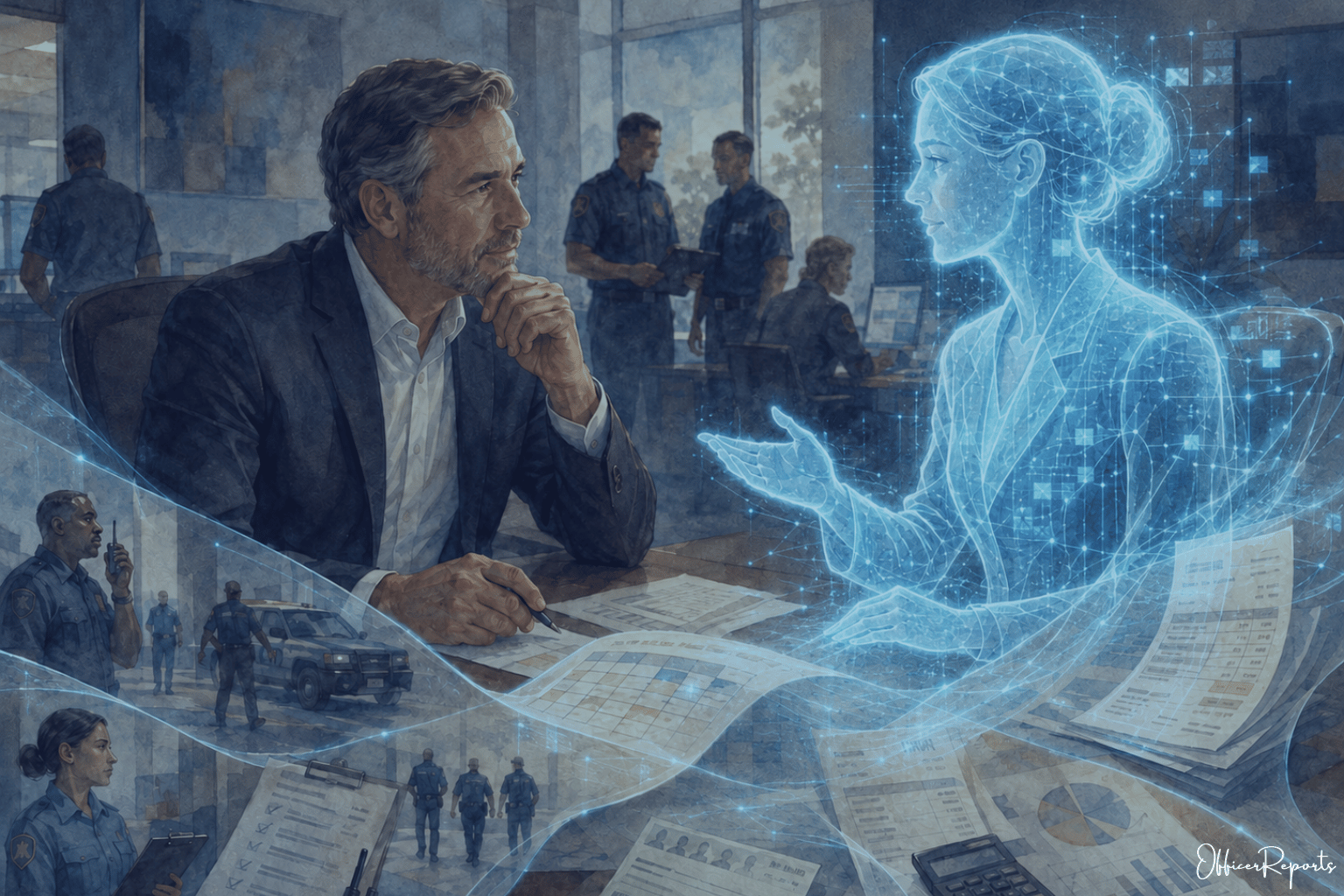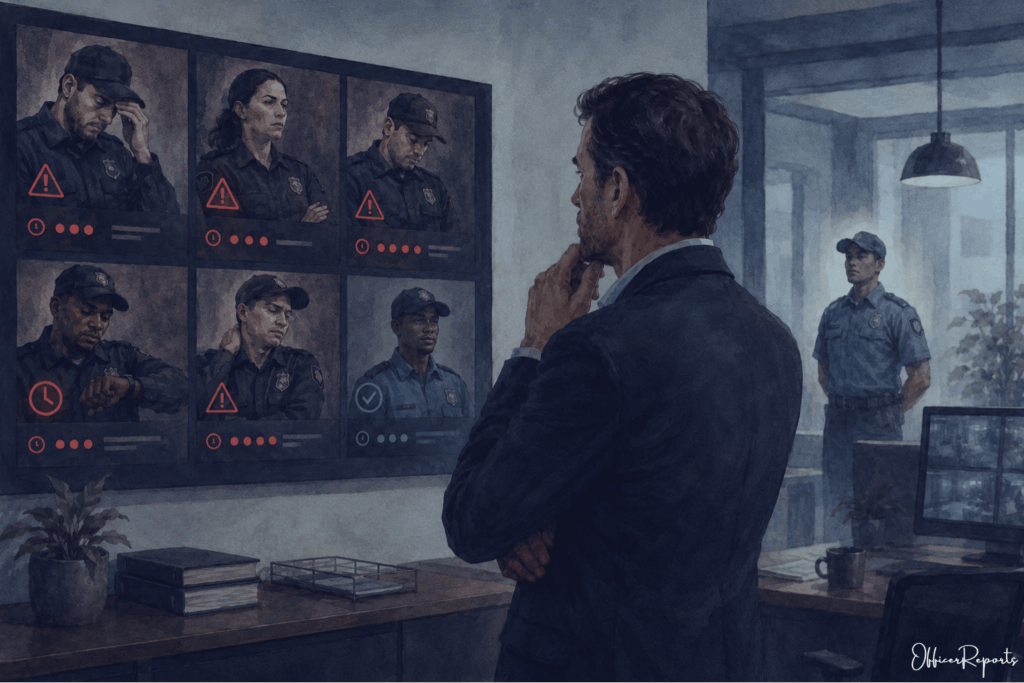
There is a question at the center of security supervision that every security company owner thinks they can answer until the company gets large enough to make the answer uncomfortable: Who are your best officers?
When our company had 20 officers, we generally knew. When we had 50 officers, we still had a pretty good feel for it. Even at 100 officers, the strongest people were usually visible enough that leadership could identify them with some level of confidence. We knew who could be trusted, who handled themselves professionally, who showed up consistently, and who clients seemed to appreciate.
But once we reached roughly 150+ officers, that changed. We could still identify the obvious problems. We knew who had attendance issues or who generated complaints. Poor performance was easy to see because poor performance creates noise.
What became much harder was identifying the officers who were quietly doing excellent work. The reliable officer who showed up every day. The consistent officer who completed patrols without drama. The professional officer who wrote solid reports, followed post orders, avoided complaints, and rarely required management attention. Those officers were valuable, but they were not always visible.
That realization exposed a real leadership problem. In a growing security company, the information needed to understand officer performance often exists, but it is scattered across reports, schedules, attendance records, supervisor observations, patrol activity, and client feedback. No single person can easily hold all of it in their head. As a result, the company may know who is causing problems but still struggle to identify who is consistently creating value for its clients.
Why Bad Officers Are Easier To Find
Security companies are often better at detecting failure than recognizing excellence. That is not because owners or supervisors do not care about good officers. It is because the operation naturally pulls attention toward problems.
A missed shift creates an immediate issue. A late arrival affects the client, and there is a security officer named tied to it. A client complaint creates a conversation, and there is a security officer named tied to it. A disciplinary matter demands documentation, and there is a security officer named on it. These events create visible signals that move quickly through the organization, and those officers’ become recognized as bad employees…”What did Smith do this time?!?!”
Strong performance works differently. Many of the best officers do not create noise. They show up, perform their duties, complete their reports, follow instructions, and avoid unnecessary problems. In many cases, their value is found in the absence of disruption.
That dynamic creates an irony in security operations. The officers who require the least attention may also receive the least recognition. They are doing exactly what the company wants them to do, but because nothing is going wrong, their performance can fade into the background.
This becomes more pronounced as the company grows. At a smaller scale, leaders can rely on memory, proximity, and informal awareness. At a larger scale, those methods begin to break down. The company may still believe it knows its people, but the confidence behind that belief becomes less reliable.
The Hidden Cost Of Subjective Promotions
When performance is difficult to see clearly, promotions often become more subjective than owners would like to admit. Advancement decisions may be influenced by visibility, relationships, self promotion, or the perception of leadership potential rather than consistent, measurable performance.
This does not usually happen because anyone is intentionally trying to be unfair. It happens because managers make decisions with the information available to them. If one officer actively pursues promotion, speaks often with supervisors, and makes their ambition known, that officer becomes visible. Unfortunately, another officer may be more consistent, more reliable, and more respected by clients, but if that performance is not clearly surfaced, it may not carry the same weight.
We experienced this ourselves. As we grew, we sometimes promoted people who were good at jockeying for opportunities while quieter, deserving officers may have gone unrecognized. Looking back, that was not just a promotion problem. It was a visibility problem. This matters because promotions send a message throughout the organization. Officers pay attention to who gets recognized, who gets advanced, and what behavior appears to be rewarded. If they believe advancement is based more on politics than performance, morale suffers. If they believe consistent work goes unnoticed, motivation weakens.
A security company, or any other company, cannot build a merit-based culture on hidden performance. Meritocracy requires visibility. Without it, even well-intentioned leaders can make decisions that feel inconsistent or unfair to the people doing the work.
Why Recognition Often Fails
Most security companies have systems for documenting mistakes. Very few have systems for recognizing excellence.
That imbalance shapes the employee experience more than many owners realize. An officer who makes a mistake receives immediate attention. There may be a phone call, a write up, a meeting, or a corrective action. The company has a process for responding when something goes wrong.
But the officer who performs well every day may receive very little feedback because nothing requires intervention. Their consistency becomes expected. Their reliability becomes assumed. Their professionalism becomes part of the background.
This is one of the reasons recognition often fails in security companies. It depends too heavily on memory and manager discretion. A good supervisor may recognize strong performance when they see it, but no supervisor can see everything. As the company grows, recognition becomes harder to scale because the signals of good performance are spread across too many people, locations, systems, and client interactions.
The result is that recognition becomes inconsistent. Some officers are praised because they happen to be seen. Others are overlooked because their work is solid but quiet. Over time, this creates a culture where mistakes are documented more consistently than excellence is recognized.
That is a problem for an industry that depends so heavily on human performance.

Gamification As Structured Recognition
Gamification is often misunderstood. In many business conversations, it gets reduced to points, badges, and leaderboards. That framing can make it sound shallow, especially in an industry as operationally serious as security.
But the real value of gamification is not entertainment. The real value is visibility.
At its best, gamification helps people understand how they are performing, how they are improving, what behaviors are valued, and how their efforts are being recognized. It creates a structure around performance signals that might otherwise remain buried. For security companies, this matters because so much good performance is invisible. An officer may arrive on time for every shift, complete every patrol, submit quality reports, avoid complaints, and consistently follow post orders. Those behaviors are valuable, but unless the company has a way to surface them, they may never become part of the officer’s story.
Gamification can help turn quiet consistency into visible recognition. It can show officers that the company is paying attention not only when something goes wrong, but also when something goes right. In that sense, gamification is not about making security work feel like a game. It is about making positive performance easier to see, measure, and acknowledge.
That distinction is important. Security companies do not need gimmicks. They need better ways to reinforce the behaviors that create strong operations.
Why Security Companies Need Recognition More Than Most Industries
Security work can be isolating. Many officers work alone, at night, or at posts where they may not see a supervisor often. They may interact with clients more than they interact with company leadership. In that environment, it is easy for good officers to feel disconnected from the organization.
This is one reason recognition matters so much in the security industry. A great officer may not close a deal, lead a meeting, or produce a visible project that everyone in the company can see. Their value is often demonstrated through consistency, professionalism, presence, and judgment.
Those contributions are easy to underestimate because they do not always create dramatic moments. The best security work often prevents problems rather than responding to them. When an officer does the job well, nothing may happen, and nothing happening can be the entire point.
That makes recognition more difficult but also more necessary. If a company only responds to visible problems, it unintentionally trains the organization to focus on failure. If it also finds ways to recognize consistency, professionalism, and improvement, it creates a healthier performance culture.
Most security companies have systems for documenting mistakes. Few have systems for recognizing excellence. That gap is one of the biggest opportunities in modern security supervision.
Annual Reviews Were Designed For A Different Era
Traditional performance reviews were built for a slower, more manual management environment. They rely heavily on supervisor memory, occasional observations, and whatever documentation happens to be available at the time of review.
That approach has obvious limitations in security. Officers work across different sites, schedules, clients, and conditions. Supervisors may not see each officer often enough to form a complete picture. Even when data exists, it may be spread across reports, attendance systems, payroll records, scheduling notes, incident history, and client communications.
By the time an annual review happens, the conversation may depend more on what people remember than what actually happened over time. Recent events can carry too much weight. Quiet consistency can be forgotten.
This does not mean performance reviews have no value. It means annual reviews are not enough. Security operations generate too much information, too continuously, for security supervision to depend on occasional reflection.
The industry needs a model that matches the pace of the work. Performance is not annual. Attendance is not annual. Report quality is not annual. Patrol completion is not annual. Client satisfaction is not annual. These things happen every day, and supervision should be able to understand them as they happen.
The Coaching Gap in Security Supervision
Many companies, including ours, are already using AI to coach sales teams because sales managers cannot listen to every call. The logic is simple. If a sales team generates hundreds or thousands of calls, managers need help identifying patterns, coaching opportunities, and examples of strong or weak performance.
Security companies face a similar problem, but the industry has been slower to frame it that way. Supervisors cannot realistically evaluate every DAR, review every attendance pattern, inspect every tour stop record, and connect every client concern to officer performance at scale.
Because of that, coaching often becomes reactive. An officer receives coaching after a client complains, after a report is poorly written, after a shift is missed, or after a supervisor notices a problem. By then, the issue may already have affected the client or the officer’s standing with the company. A better supervision model would identify coaching opportunities earlier. It would help supervisors see which officers may be struggling with report quality, which officers are improving, which officers are consistently reliable, and which officers may need intervention before a problem becomes serious.
Security guard company systems should give better visibility so supervisors can spend more time coaching and less time searching for the information that tells them who needs help.
The Future Of Security Supervision Is Continuous
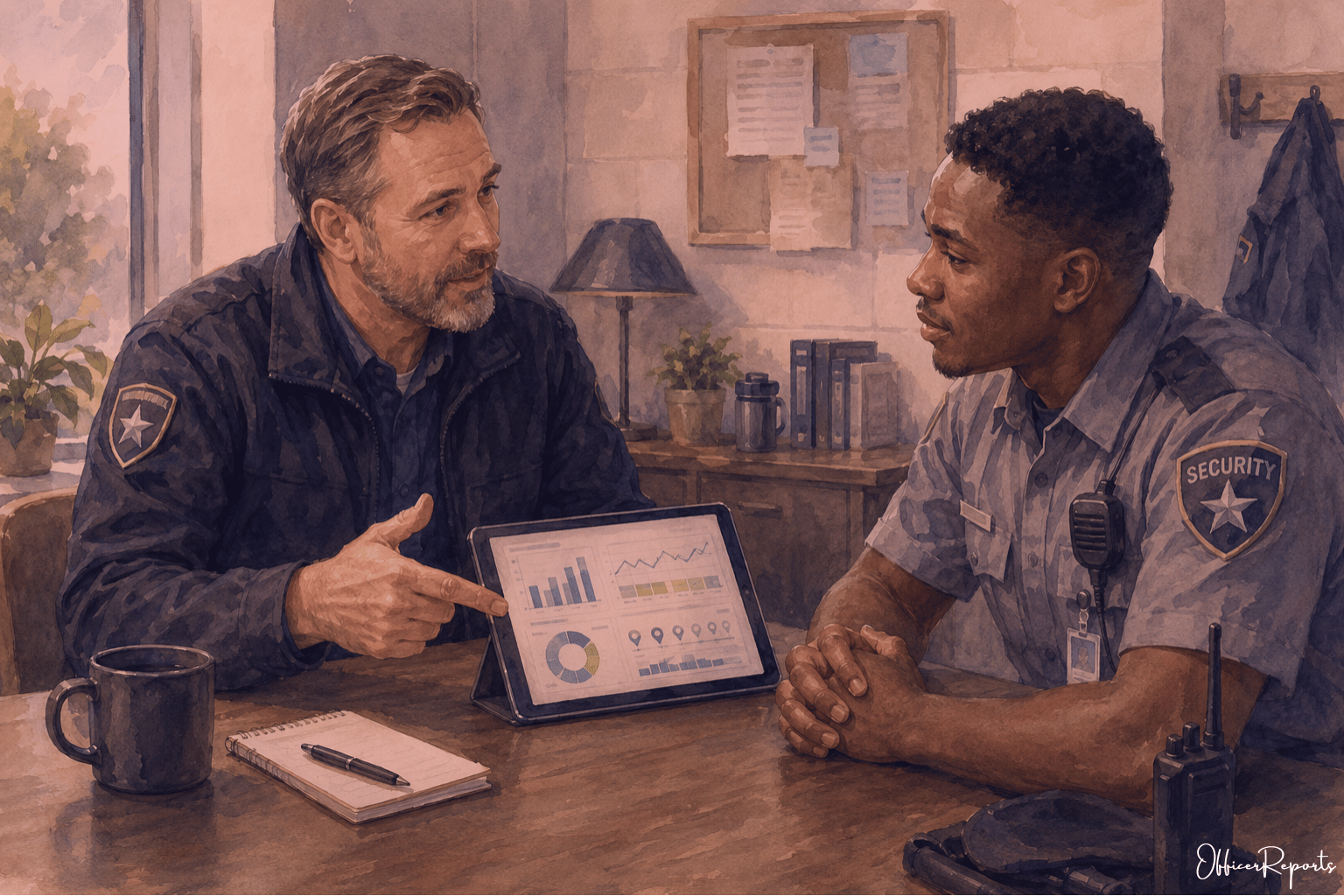
The future of security supervision is not an annual review process supported by scattered notes and imperfect memory. It is continuous visibility, continuous coaching, and continuous recognition.
In a continuous supervision model, performance information is not reviewed only when there is a problem or when a review period arrives. It is understood as part of the daily operation. Supervisors can see patterns as they develop. Managers can recognize strong performance while it is still timely. Coaching can happen before small issues become larger ones.
This changes the role of the supervisor in a meaningful way. Instead of spending so much time collecting information, supervisors can spend more time interpreting it and acting on it. They can mentor officers, recognize improvement, reinforce standards, and make better decisions about development and advancement.
That is a more realistic model for the modern security company. As companies grow, supervision cannot rely only on personal familiarity. The owner may not know every officer. The operations manager may not see every post. The field supervisor may not have enough time to observe every pattern manually.
Continuous supervision does not eliminate the human element. It strengthens it by giving leaders a clearer view of what is actually happening across the company.
Why AI Changes The Equation For Security Supervision
AI changes the equation because it can help surface patterns that humans struggle to identify manually at scale. That does not mean AI should manage officers, replace supervisors, or make promotion decisions on its own. Those would be the wrong goals.
The better goal is visibility.
AI can help evaluate report quality across large volumes of activity. It can identify trends in attendance, documentation, patrol completion, and performance patterns. It can surface coaching opportunities that might otherwise remain hidden. It can help highlight exceptional performance that deserves recognition but may not have created enough noise to reach management’s attention.
This is where AI has practical value for security companies. Not as a replacement for judgment, but as a force multiplier for security supervision. It can help supervisors see more, sooner, and with greater consistency.
The distinction matters. Security is still a people business. Officers need leadership, coaching, context, and human judgment. But supervisors need better tools to understand performance across a growing operation. AI can help close that gap by organizing information into signals leaders can actually use.
The goal is not automated management. The goal is better management through better visibility.
Why Better Security Supervision Requires Measurement
Every owner wants to believe their company rewards performance. But performance has to be seen before it can be rewarded.
If a company wants merit based promotions, it needs measurable indicators of merit. If it wants merit based recognition, it needs a way to identify the behaviors worth recognizing. If it wants merit based coaching, it needs to know who is improving, who is struggling, and where support is needed. Without measurement, decisions become subjective. Subjective decisions are not always wrong, but they are vulnerable to bias, memory gaps, relationships, and visibility differences. The officer who is most vocal may appear more promotable than the officer who is most consistent. The officer who avoids problems may receive less attention than the officer who creates them.
That is not the culture most security guard company owners want to build.
The best officers deserve to be recognized! Struggling officers deserve coaching before failure becomes a pattern. Supervisors deserve tools that help them lead with better information. None of that happens consistently when performance remains hidden.
A merit based culture requires more than good intentions. It requires a system that makes performance visible enough to act on.
What We Are Building Toward
One of the reasons we began developing our soon-to-be-released Supervisor Agent is that I experienced this problem firsthand. I understood what it felt like to grow past the point where leadership could confidently identify the best officers by memory and observation alone.
The goal is not simply to build another technology feature. The larger goal is to create continuous visibility into officer performance so supervisors can recognize strong performers, identify coaching opportunities, make better promotion decisions, and build a more merit-based culture.
AI can help evaluate report quality. It can surface performance patterns that are difficult to identify manually. It can help supervisors understand where attention is needed and where recognition is deserved. But the purpose is not to remove the supervisor from the process.
The purpose is to give supervisors and managers a better starting point.
Security companies do not need less leadership. They need more informed leadership. They need security supervision that can scale without becoming impersonal, inconsistent, or purely reactive. So we embarked on the journey to give you just that.
The Question Still Matters
The question remains the same. Who are your best officers?
Not simply who receives the fewest complaints. Not who has been employed the longest. Not who asks for promotion most often. Not who happens to be most visible to management.
The real question is who consistently demonstrates professionalism, consistently performs well, consistently creates value for the client, and consistently represents the company as ownership would want it represented.
The companies that answer that question most effectively will have a significant advantage. They will be better positioned to retain strong officers, coach struggling officers, develop future leaders, and build cultures where performance is recognized rather than assumed.
The future of security supervision is not annual reviews. It is continuous understanding!
By Courtney Sparkman
 Courtney is the founder and CEO of OfficerApps.com, a security guard company software provider, specializing in security guard management software, and publisher of Security Guard Services Magazine. He is a renowned author and security industry syndicator who also hosts an active YouTube channel, helping thousands of his subscribers to grow their security guard services companies.