Artificial intelligence has become one of the most discussed topics in business software, and the security industry is no exception. Every week, another vendor seems to be talking about AI assistants, AI agents, AI insights, or the importance of connecting AI to your company’s data. For security company owners, the language can sound impressive, but it does not always explain what is actually changing inside the business or what the future of AI for security companies is.
That is why the conversation around AI for security companies needs to be more practical. Security company owners do not need vague promises about the future. They need to understand what AI can actually do when it has access to the operational, workforce, client, and financial information already within their company.
The future of AI for security companies is not simply more reports. Most companies already have plenty of reports. Officers complete daily activity reports, incident reports, patrol logs, site notes, and supervisor updates daily. The problem is not that security companies lack information. The problem is that much of that information is difficult to understand at scale.
Connecting AI to business data does not magically make AI smarter. It gives AI context. Without your business data, AI can understand general security concepts. With your business data, AI can begin to understand how your specific security operation actually works.
That is where the real opportunity begins.
Why Generic AI for Security Companies Is Not Enough
A generic AI system can already explain many basic security concepts. It can describe what a daily activity report is, explain why patrols matter, outline common incident reporting practices, and summarize general post order procedures. That kind of knowledge can be useful, but it is still general knowledge. What AI does not know on its own is your company.
It does not know your officers, your clients, your sites, your post orders, your schedules, your reports, your payroll burden, or the expectations built into each contract. It does not know which locations are stable and which ones require constant management attention. It does not know which supervisors are stretched thin or which clients quietly consume more time than the contract seems to justify.
That is the limitation of AI without business context. AI cannot analyze information it cannot see. For AI for security companies to become truly valuable, it has to move beyond general knowledge and into company specific context.
The Difference Between Knowledge And Context
There is a major difference between knowledge and context. Knowledge allows AI to explain what something means in general. Context allows AI to understand what something means inside your business.
For example, AI may know that missed patrols can create risk. That knowledge becomes more useful when AI can see that missed patrols are happening more often at a particular site, during a particular shift, after repeated schedule changes, or when a specific post is staffed with newer officers. At that point, the conversation changes from theory to operational relevance.
The same is true with reporting quality. AI may know what a good incident report should contain, but that is different from understanding which officers in your company write the strongest reports, which locations produce the most vague daily activity reports, or which client sites generate the most management follow-up.
Context transforms information into relevance. That is why AI for security companies should not be viewed as a generic chatbot added to a business. It should be viewed as a way to help owners understand the information already being created across their operations.
What Business Data Makes AI for Security Companies Useful
When people talk about connecting AI to business data, it can sound technical. In reality, security companies already generate the kinds of information that make AI valuable. The challenge is that this information often lives in different systems, different formats, and different parts of the business.
Operational data includes daily activity reports, incident reports, patrol activity, GPS records, site visits, field notes, and supervisor observations. This information shows what is happening in the field. It reflects the daily rhythm of the operation, the exceptions that occur, and the work officers are performing across client sites.
Workforce data tells another part of the story. This includes schedules, attendance, training records, timekeeping information, performance notes, and staffing history. It helps explain whether the company has the right people in the right places and whether certain sites are creating more strain on the workforce than others.
Client data adds important context. Post orders, site instructions, service expectations, contract requirements, and client preferences all shape what good performance actually means at each location. A report or patrol record cannot be fully understood without knowing what the officer was expected to do in the first place.
Financial data completes the picture. Payroll, invoicing, accounting information, overtime, labor burden, and contract profitability show the economic reality behind the operation. A site may appear stable operationally while still creating financial pressure. Another site may generate frequent issues but remain profitable because the contract was priced correctly.
Each category of information matters on its own. The larger opportunity appears when AI can help security company owners understand how these categories relate to one another.
AI for Security Companies Should Create Intelligence, Not More Data
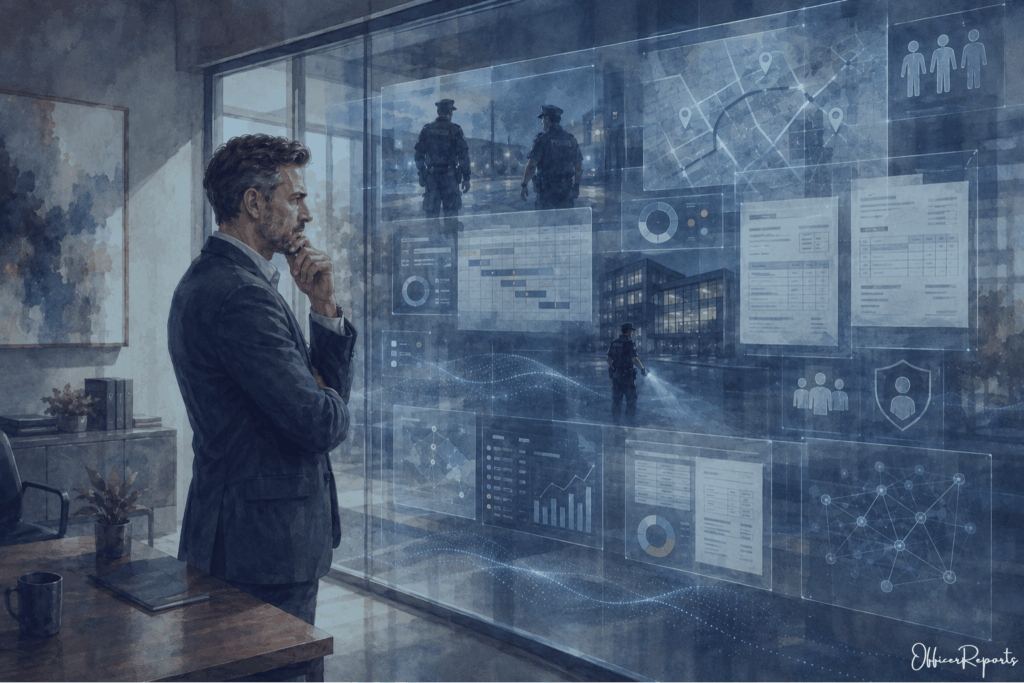
Most security companies already have plenty of data. The problem is not usually a lack of information. The problem is that the information is difficult to interpret across the business. Data tells you what happened. Intelligence helps explain why it happened.
A company may know that turnover increased. That is data. But intelligence would help show whether turnover increased primarily at sites where overtime exceeded normal levels, where schedules changed frequently, where supervisors were stretched, or where officers were assigned to posts that did not match their training or experience.
A company may know that a client location is generating more incidents. That is data. Intelligence would help determine whether those incidents are tied to a staffing issue, a change in site conditions, unclear post orders, weak reporting, or a client expectation that is not being properly managed.
This is where AI for security companies becomes more meaningful. AI is not valuable because it magically creates answers. It becomes valuable when it helps identify relationships within information the company already has but has not been able to examine deeply enough.
The best use of AI is not to create more noise. It is to help owners see the signal inside the noise.

What Happens When AI for Security Companies Can Access Real Business Data
When AI can access security company data, it can begin identifying patterns, relationships, anomalies, and recurring issues. This does not mean AI is automatically correct, and it does not mean human judgment becomes less important. It means owners and operators can begin asking better questions of the information already flowing through the company.
The important point is that AI is not creating the underlying information. It is helping the company see relationships within information that already exists. For security company owners, that distinction matters because the goal is not to replace experience. The goal is to give experienced operators better visibility.
Why Many AI Projects Disappoint
Many AI projects disappoint because expectations are set incorrectly. Companies assume that once AI is connected, it should immediately tell them something remarkable. But AI does not fix weak information systems. It exposes them.
If business data is incomplete, inconsistent, inaccurate, or poorly organized, AI has very little reliable context to work with. If officers are not completing reports properly, if schedules are constantly being changed outside the system, if payroll data is disconnected from operations, or if client expectations are not documented clearly, AI will struggle to produce meaningful insight.
This is why business intelligence for security companies cannot be separated from operational discipline. Better intelligence depends on better information. Better information depends on better systems, better processes, and better habits across the company.
AI amplifies the quality of your information systems. If the foundation is strong, AI can help make the business more understandable. If the foundation is weak, AI may only make the confusion more visible.
That is one reason that AI for security companies should be approached thoughtfully. The companies that benefit most will likely be those that already prioritize operational consistency, clean documentation, proper scheduling, accurate payroll, and clear client expectations.
What Happens When AI Can See More Than One System?
Most security company software has traditionally operated in silos. Reporting software captures field activity. Scheduling software manages shifts. Payroll software calculates labor. Accounting software tracks invoices and financial performance. Each system may be useful, but each one only tells part of the story. The real opportunity emerges when AI can understand relationships across these systems.
This is where AI for security companies becomes much bigger than report writing. A daily activity report may tell you what happened at a site. Payroll data may tell you what it cost to staff that site. Accounting data may tell you what the client was billed. Scheduling data may tell you how much overtime was required to keep the post covered.
Individually, those data points are useful. Together, they begin to tell the truth about the business.
That is why integrations matter. A QuickBooks integration is not just about moving accounting information from one system to another. A payroll integration is not just about reducing duplicate entry. These connections matter because AI becomes more useful when it can understand the relationship between operations, labor, and financial performance.
Understanding Which Clients Are Actually Profitable
A security company may believe a client is profitable because the invoice amount is large or because the contract has been in place for years. But revenue alone does not tell the full story. Some clients consume more supervisory time, require more overtime, create more administrative follow-up, or place greater strain on the operation.
AI connected to OfficerReports, payroll, and QuickBooks could help a company better understand that relationship. It could help identify the difference between a client that produces revenue and a client that produces healthy profit.
For example, one client may appear attractive because the monthly billing is high. But when overtime, supervisor visits, schedule instability, and administrative workload are considered together, the true margin may be much thinner than expected. Another client may generate less revenue but require fewer interventions, produce fewer issues, and operate more predictably.
That kind of understanding can change how an owner thinks about growth. Not all revenue is equally valuable. AI for security companies becomes especially powerful when it helps owners understand which accounts support the business and which accounts quietly drain it.
This is also where AI connects directly to sales strategy. If a company understands the operational burden behind each contract, it can price more intelligently, explain pricing more clearly, and avoid competing only on the lowest bid.
How AI for Security Companies Can Reveal The True Cost Of Turnover
Turnover is one of the most familiar challenges in the security industry, but many companies struggle to understand its full cost. The direct cost of replacing an officer is only part of the issue. Turnover can also create overtime, supervisor strain, training gaps, client dissatisfaction, scheduling disruption, and reduced consistency at the site level.
AI connected to recruiting, onboarding, payroll, scheduling, and operations could help a company examine turnover more completely. Instead of simply knowing that officers are leaving, the company could begin to understand where turnover is most expensive and what conditions appear to contribute to it.
For example, if turnover is higher at sites with frequent schedule changes, excessive overtime, unclear post orders, or recurring incident activity, that information gives leadership something more useful than a general turnover number. It provides a starting point for action.
The goal is not to reduce a complex workforce issue to a simple formula. The goal is to give owners a clearer view of the conditions that may be influencing the problem.
Understanding Why Sites Struggle
Every security company has sites that require more attention than others. Sometimes the reasons are obvious. Other times, the site simply feels difficult. Supervisors know it. Dispatchers know it. Officers know it. But the underlying cause is not always clear.
AI connected to security guard company data could help identify relationships between overtime, staffing gaps, incident activity, schedule instability, missed patrols, report quality, and turnover. That broader view can help explain why a site is underperforming.
A site may not be struggling because of one bad officer or one difficult client. It may be struggling because the schedule is unstable, the post orders are unclear, overtime is too frequent, and supervisors are being forced into reactive problem solving. When those patterns are seen together, leadership can address the system around the site rather than chasing symptoms.
This is where operational intelligence becomes especially valuable. It helps owners see the difference between isolated problems and recurring patterns. For AI for security companies to be useful, it has to help operators understand those patterns in a way that leads to better decisions.
Understanding What Creates High Performing Officers
Security companies often know who their strongest officers are, but they may not always understand why those officers perform well. Some are reliable. Some write strong reports. Some build trust with clients. Some handle difficult posts with professionalism. Some become future supervisors.
AI connected to training, attendance, reporting quality, tenure, scheduling history, and promotion data could help identify the characteristics that appear more often among high-performing officers. It may reveal patterns in training completion, site assignment, attendance, experience level, or reporting behavior.
That information could help companies make better decisions about recruiting, onboarding, training, retention, and promotion. It could also help them identify officers who may be ready for more responsibility but have not yet been noticed through traditional management channels.
This is not about replacing manager judgment. It is about giving managers better visibility into the workforce they are already responsible for leading.
How AI for Security Companies Can Improve Contract Pricing Decisions
Pricing is one of the most important decisions a security company makes, yet many contracts are still priced with incomplete information. Companies often consider wage rates, bill rates, payroll taxes, benefits, and basic overhead. Those factors matter, but they do not always capture the full operational burden of a contract.
AI connected to payroll, operations, scheduling, and accounting could help companies better understand labor burden, management overhead, overtime exposure, incident frequency, supervisor involvement, and contract profitability. That kind of insight could support better pricing decisions before the proposal is submitted and better contract management after the work begins.
This matters because pricing is not just a sales issue. It is an operational issue. A contract that is priced too tightly can limit the company’s ability to train, supervise, manage, and deliver the level of service the client expects. When owners can explain what drives pricing, they are in a stronger position to show why a lower price may reduce some aspect of service.
This is one of the reasons our QuickBooks integration and soon-to-be-announced payroll integrations are part of a larger vision. The point is not simply moving information between systems. The point is creating a more complete understanding of how operational activity connects to financial performance.

Why This Is Bigger Than Automation
Most conversations about AI focus on saving time. That is understandable. Security companies have a lot of repetitive administrative work, and automation can be useful when applied carefully. But if the conversation stops there, the larger opportunity is missed.
The biggest opportunity is not doing work faster, it is understanding the business more clearly.
For a security company owner, that understanding can influence staffing, pricing, supervision, training, client management, and growth strategy. It can help identify which accounts deserve more attention, which sites are becoming unstable, which officers may need support, and which contracts may not be as profitable as they appear.
Automation can reduce effort. Intelligence can improve judgment. Both have value, but they are not the same thing.
That is why the future of AI for security companies is not more reports. It is a better understanding of the business behind the reports.
Why The Security Industry Has A Unique Advantage
The security industry generates enormous amounts of operational information. Officers write reports, complete patrols, document observations, record incidents, follow post orders, clock in and out, move across sites, and interact with clients every day. Few industries produce such a steady stream of real-world operational data.
Historically, much of that information has been stored but not deeply understood. Reports were reviewed when needed. Patrols were checked when there was a concern. Incidents were handled individually. Schedules were managed as staffing problems arose. Financial data was reviewed separately from operational performance.
AI changes what becomes possible because it can help make sense of information at scale. It can help connect the daily details of the operation to the larger patterns shaping the business.
That is why AI for security companies should not be viewed only as a writing tool, a chatbot, or a dashboard enhancement. The more meaningful opportunity is using AI to help owners understand what is happening across the business with more clarity and context.
How This Connects To OfficerIntelligence
The long term vision for OfficerIntelligence is not simply to generate more reports or create more dashboards. Security companies do not need more places to look. They need better understanding of what their information means.
OfficerIntelligence is about transforming operational, workforce, and financial information into a continuous intelligence layer that helps security company owners understand the health and performance of their businesses. That includes reports, clock ins, GPS activity, patrols, schedules, post orders, payroll data, accounting information, and the other signals that shape daily operations.
The QuickBooks integration is one step in that direction. Future payroll integrations are another. Each connection helps create a more complete picture of the business. As AI gains access to more relevant information, the value is not simply that systems can communicate. The value is that the business becomes easier to understand.
That understanding becomes increasingly important as security companies grow. The larger the operation becomes, the harder it is for owners to rely on instinct alone. AI does not remove the need for leadership, judgment, or experience. It gives those qualities better information to work with.
Final Thought
Most people think connecting AI to business data means making AI smarter. That is not quite right.
A better way to think about it is that connecting AI to business data makes the business easier to understand. It gives AI the context needed to help owners see patterns, relationships, risks, and opportunities that may already exist inside the operation but are difficult to recognize across disconnected systems.
For security company owners, that may become one of the most important shifts in the industry. The future of AI for security companies is not just about faster reports or automated tasks. It is about building a clearer view of the business itself.
And in an industry where margins, staffing, service quality, and client expectations are constantly connected, that clarity may become one of the most valuable advantages a company can have.
By Courtney Sparkman
 Courtney is the founder and CEO of OfficerApps.com, a security guard company software provider, specializing in security guard management software, and publisher of Security Guard Services Magazine. He is a renowned author and security industry syndicator who also hosts an active YouTube channel, helping thousands of his subscribers to grow their security guard services companies.