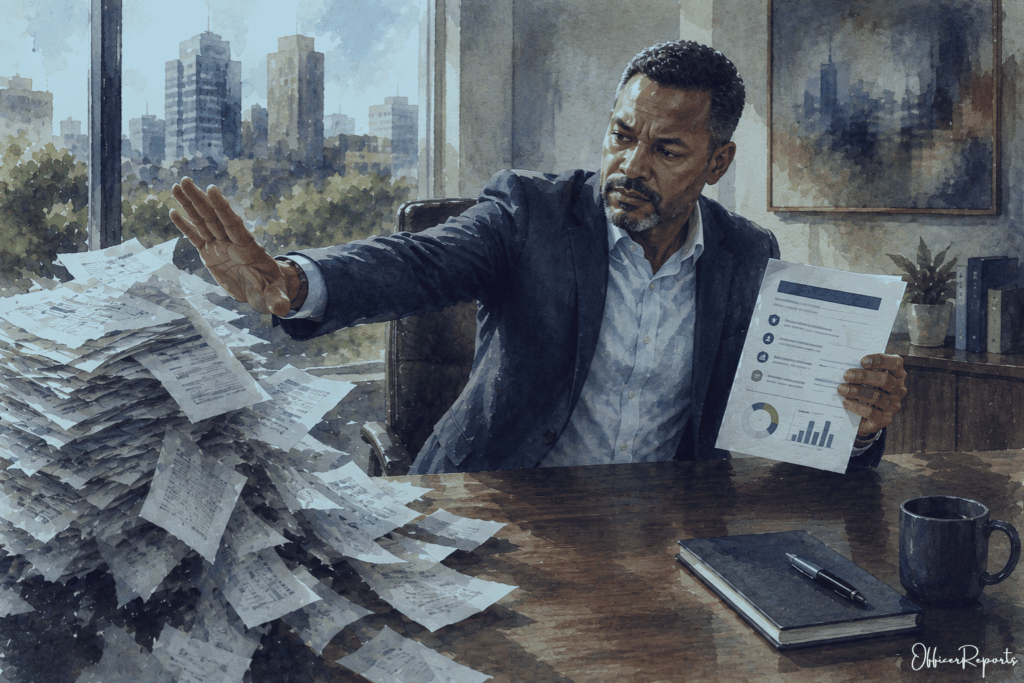
For decades, security companies have treated reporting as one of the primary ways to demonstrate value to clients. Throughout each shift, security officers document patrol activity, property observations, site issues, and operational updates inside daily activity reports intended to show accountability and patrol coverage. Incident reports may still be created separately for significant events, but security guard daily activity reports often become the primary document clients review to understand what happened across a property each day. But increasingly, clients are signaling that the traditional format is becoming less valuable.
Several security companies recently told us they won new business after prospective clients expressed frustration with the reporting they were receiving from their previous security provider. The issue was not that the reports lacked detail. In fact, the reports contained too much of it. One client summarized the problem clearly:
“We don’t want any more 11 page reports.”
That statement reflects a larger shift taking place across the industry. Clients are not asking for more documentation. They are asking for a better understanding. Many traditional daily activity reports for security companies are meant to give clients a volume of information without providing clarity. Important operational issues become buried inside long chronological logs, priorities become difficult to identify, and clients are often left skimming reports rather than truly understanding what happened at their property.
This is one of the reasons reporting is beginning to evolve. The future of reporting is becoming less about documenting every action and more about helping clients quickly understand what matters operationally.
Why Traditional Security Guard Daily Activity Reports Are Losing Value
Traditional security guard daily activity reports were originally designed around documentation. Their purpose was to create a written operational record that clients and managers could reference later if questions arose. In many ways, they functioned more like archives than communication tools.
That structure made sense when the primary concern was whether information existed at all. Today, however, most clients are not struggling with a lack of information. They are struggling to process and interpret the volume of information they receive.
Many security shift reports now contain dozens or even hundreds of individual activity entries covering patrols, observations, maintenance concerns, visitor activity, parking issues, and routine operational updates. While all of those details may technically matter, the cumulative effect often works against the client. Important information becomes harder to identify precisely because it is buried in excessive detail.
In practice, many clients begin skimming reports or ignoring them altogether. Not because they do not care about the operation, but because the reports no longer communicate what is operationally important efficiently.
This is one of the larger limitations many forms of security reporting software are beginning to encounter. The industry has spent years improving how to collect more information without equally improving how that information is prioritized and communicated.
AI Changes the Nature of Reporting
Artificial intelligence is beginning to change reporting in ways that many people did not expect. The real opportunity is not that AI can help officers write security guard daily activity reports faster, because that is a dangerous proposition. The larger opportunity is that AI can help transform raw operational activity into organized operational understanding. That distinction matters.
Traditional reports primarily answer the question:
What happened?
AI driven reporting increasingly helps answer a different question:
What matters?
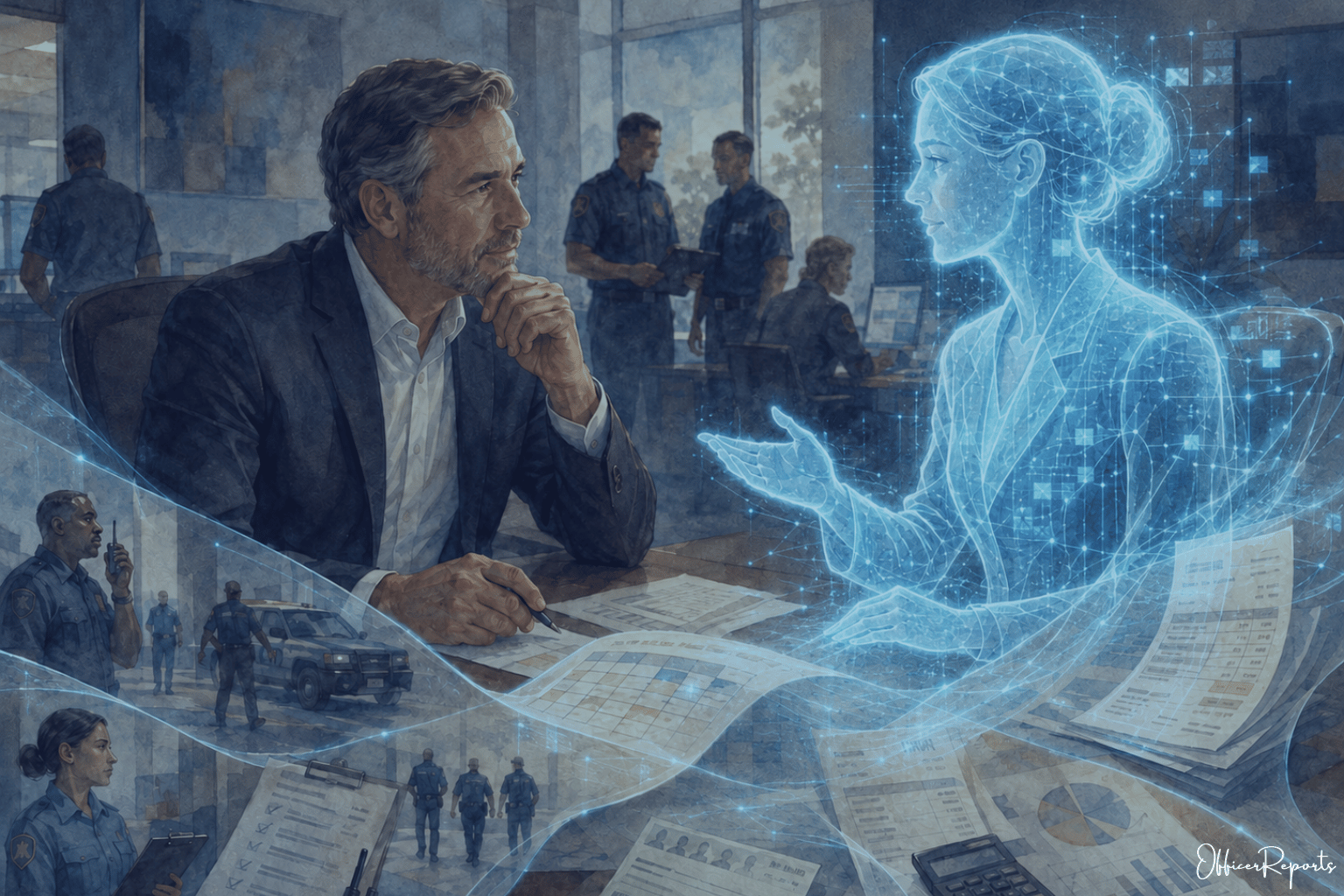
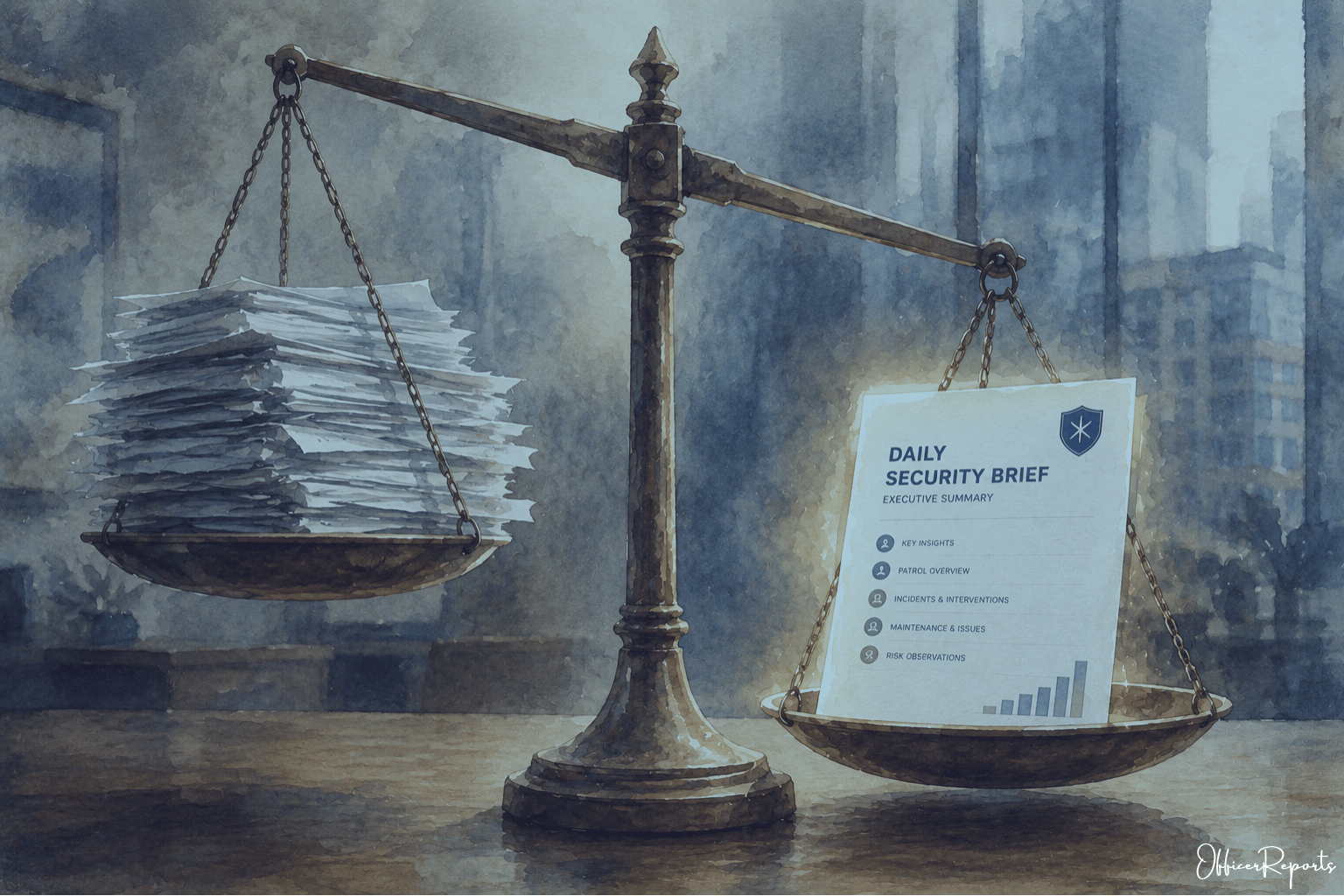
This changes how information is consumed by clients. Instead of reviewing pages of chronological activity logs, clients can receive summarized operational insights that highlight key incidents, recurring issues, unusual activity patterns, officer interventions, and emerging concerns.
The value is not necessarily in reducing the amount of information collected. The value is in improving prioritization, context, and visibility.
This is where AI security guard software begins to change the client experience. Rather than forcing clients to interpret dozens or hundreds of disconnected entries themselves, AI can help organize operational activity into something more understandable and actionable.
That evolution is becoming increasingly important as clients expect faster understanding and clearer communication from their security providers.
The Client Who Became an Advocate
One security company customer experienced this shift firsthand.
Their client had begun to question whether the security officers were actually doing their jobs effectively. From the client’s perspective, they were paying for security coverage but did not clearly see or understand what duties the security officer was performing at the property each day.
The security company responded by providing the client with an AI-generated Daily Security Brief. Once the client reviewed the report, the conversation changed almost immediately. The brief clearly summarized patrol activity, officer interventions, property observations, operational concerns, and site activity in a format that was easy to understand. Instead of digging through disconnected shift entries, the client could finally see the broader operational picture in one place.
The important lesson from this story is that the officers were already doing the work. The issue was visibility.
The client did not become an advocate because the operation suddenly improved overnight. The client became an advocate because the reporting finally helped them understand the value that was already being delivered.
This is one of the most important shifts occurring with AI security guard software. Better reporting does not simply document operations more efficiently. It changes how clients perceive operational value.
Clients Increasingly Want Intelligence, Not Longer Security Guard Daily Activity Reports
Most clients do not actually want every timestamp, every patrol notation, or every minor operational detail that can be presented in a security guard daily activity report. What they really want is confidence that the property is being managed effectively and awareness of issues that require attention. That distinction is significant.
Clients increasingly want to understand:
- emerging risks
- recurring issues
- operational patterns
- officer responsiveness
- property concerns
- unusual activity
- areas requiring follow-up
In other words, they want operational intelligence. This does not mean detailed records disappear. Documentation still matters, especially for liability, investigations, and accountability. But documentation alone is no longer enough to create operational understanding.
The companies that adapt most effectively to this shift will likely be the ones that learn how to combine detailed operational reporting with summarized insight and contextual communication.
That is where reporting begins to evolve from static recordkeeping into something more strategic.
The Operational Shift for Security Companies
This evolution also changes how security companies position themselves operationally.
Historically, many providers were evaluated primarily on staffing coverage and the ability to consistently produce security activity reports. But as reporting becomes more intelligent and contextual, clients have begun evaluating providers differently. They start paying closer attention to visibility, communication quality, operational awareness, and responsiveness. That creates an important opportunity for differentiation.
Companies that help clients clearly understand what is happening across their properties often strengthen trust and improve perceived value. Reporting becomes less about proving officers completed tasks and more about helping clients feel informed and operationally aware.
Over time, this can influence retention, client relationships, and even pricing conversations. When clients clearly understand the operational value being delivered, the discussion becomes less centered solely around labor hours and more focused on the overall effectiveness of the operation.
This is part of the broader shift toward operational intelligence platforms such as AI security guard software, where the focus increasingly moves beyond collecting data and toward helping clients interpret it.
Why Human Judgment Still Matters
Despite these changes, human judgment remains central to effective security operations.
AI can definitely help summarize information, identify patterns, organize reports, and improve visibility. But it does not replace operational leadership, site knowledge, client relationships, or decision making. Experienced operators will still have to provide the context that determines how information should be interpreted and acted upon.
A report may identify a recurring issue at a property, but understanding whether that issue represents a serious operational threat, a temporary anomaly, or a client specific concern still requires some level of human experience and judgment.
This is an important nuance because many discussions around AI become overly focused on automation. In reality, the strongest operational models will likely combine AI driven visibility with experienced human oversight. In the end, technology improves awareness, but operators still drive decisions.
The Future of Security Guard Daily Activity Reports
The broader direction of the industry is becoming increasingly clear.
Clients are becoming less interested in reviewing long static reports filled with disconnected entries. They increasingly expect summarized insights, operational prioritization, and a clearer understanding of what is happening across their properties.
Traditional security guard daily activity reports for security companies are unlikely to disappear entirely. The documentation that is written by your security officers will always play an important role in security operations. But the expectations surrounding reporting are clearly changing.
Static reporting alone no longer creates enough clarity for many clients. As operational environments become more complex and information volumes continue to grow, the ability to organize and communicate meaningful insights becomes increasingly valuable.
The future of reporting is not more documentation, it is clearer operational intelligence.
By Courtney Sparkman
 Courtney is the founder and CEO of OfficerApps.com, a security guard company software provider, specializing in security guard management software, and publisher of Security Guard Services Magazine. He is a renowned author and security industry syndicator who also hosts an active YouTube channel, helping thousands of his subscribers to grow their security guard services companies.