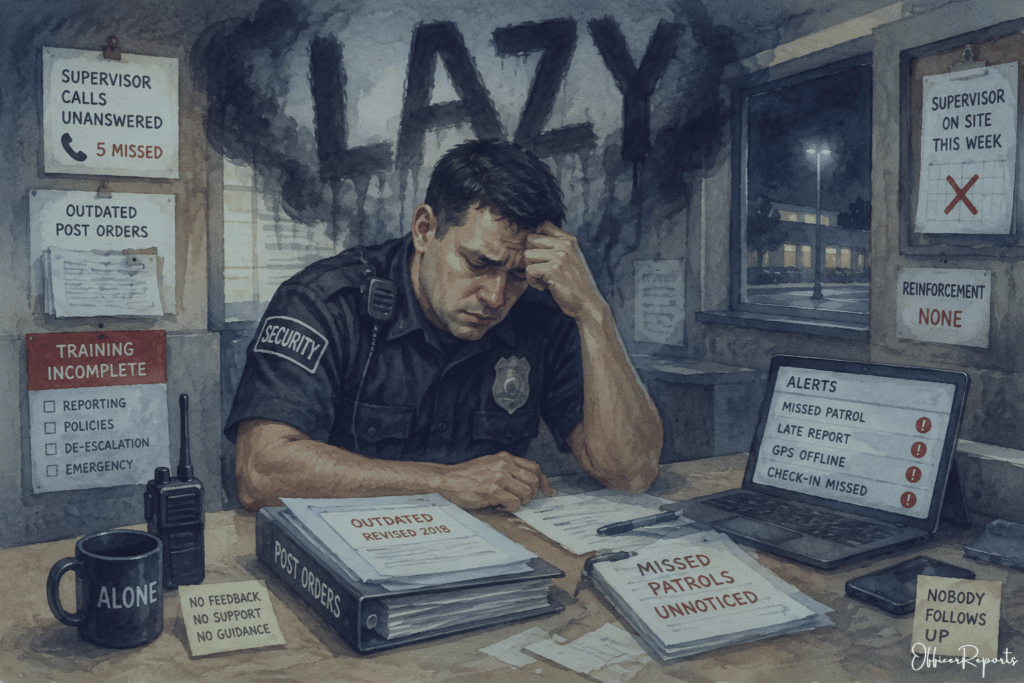
“Security guards are lazy.”…most security company owners have either said this, or something similar, privately, heard it from supervisors, or felt the frustration behind the statement after dealing with missed patrols, weak reporting, sleeping officers, or sites that consistently underperform. In some situations, the frustration is justified. I will be the first to admit that there are officers in the industry who lack urgency, avoid responsibility, or simply are not a good fit for the profession. But many of these negative situations are also rooted in deeper problems with security officer accountability that have developed over time within the company.
But when the same problems recur across officers, sites, and supervisors, leadership has to ask a more difficult question. At what point do you start viewing poor performance as an individual problem and begin to see it as a systems problem within the company?
This is where security companies can become trapped. This industry, like many others, often discusses employee disengagement as though it is purely a workforce issue, when in reality, security officer accountability is heavily shaped by leadership systems, operational structure, supervision quality, and consistency of enforcement. That does not remove responsibility from the officer, but it does change how companies should think about operational performance over the long term.
The Industry Often Treats Symptoms Instead of Systems
A common cycle exists throughout the security industry. An officer underperforms, management becomes frustrated, the officer is removed, and another person is hired to replace them. For a short time, performance improves. Then the same operational issues slowly return. Patrols become inconsistent, reports weaken, communication declines, and supervisors once again feel like they are chasing basic compliance.
When this pattern recurs, it usually points to deeper structural issues within the organization. Replacing personnel may temporarily solve the immediate problem, but it does not necessarily address the systems that drive weak security officer accountability in the first place.
This is one of the harder realities for operators to confront because replacing employees feels like an actionable step and a quick fix. Evaluating supervision quality, accountability consistency, hiring standards, and operational clarity requires leadership to examine the company itself rather than focusing entirely on the workforce…which is a much heavier lift.
What Weak Security Officer Accountability Actually Looks Like
Weak officer accountability rarely appears dramatically at first. More often, it develops through the gradual erosion of standards across the operation. Patrols become rushed or incomplete. Reports become repetitive and vague. Lastly, small responsibilities begin slipping because no one consistently corrects them.
Over time, those behaviors compound into operational inconsistency. Clients begin noticing gaps in attentiveness. Supervisors spend increasing amounts of time correcting preventable mistakes. Stronger officers become frustrated carrying weaker performers. Eventually, management begins viewing the team at the site as the primary problem.
To be clear, some officers genuinely are poor fits for the industry. Security work requires attentiveness, professionalism, reliability, and the ability to operate independently without constant supervision. Not everyone possesses those traits.
At the same time, many security officer accountability problems are reinforced by the operational environments in which the workforce operates. Officers working under unclear expectations, inconsistent supervision, weak reinforcement, and poor leadership standards often begin adapting to those conditions over time. After all, employees tend to perform according to the standards that are reinforced within the organization.
The Systems That Quietly Destroy Security Officer Accountability
Many accountability problems that appear to be motivational issues are actually downstream results of weak operational systems. Those results usually appear in 5 different areas: Hiring standards, Inconsistent Accountability, Unusable post orders, operational visibility, and lack of opportunity.
Weak Hiring Standards
Hiring is one of the clearest examples. Many companies hire primarily based on speed instead of operational fit. When staffing pressure intensifies, standards often become more flexible because reducing overtime becomes the immediate priority.
The problem is that desperation hiring frequently creates long term accountability problems later. Officers who were never properly aligned with the role’s expectations often struggle once placed on site. Management then spends months reacting to behavior that was predictable from the beginning because the hiring process focused on quickly filling shifts rather than choosing officers who were a good fit.
Expectation setting matters as well. If professionalism, reporting quality, attentiveness, and communication standards are not clearly reinforced during onboarding, many officers naturally default toward the minimum level of performance they believe the company will tolerate.
Inconsistent Accountability
Security officer accountability breaks down quickly when standards are enforced unevenly. One officer may receive corrective action for behavior that another officer routinely gets away with. Over time, employees begin learning that standards are negotiable rather than fixed.
This is where poor organizational culture begins to take shape. Culture is not created through slogans or motivational speeches. It develops through the behaviors leadership consistently reinforces, ignores, rewards, or tolerates. What leadership tolerates eventually becomes culture.
Once bad behavior goes unaddressed long enough, it stops feeling like an exception and begins to feel like the norm.
Poorly Written or Unusable Post Orders
Many companies underestimate how much operational inconsistency originates from poor post orders. Some instructions are outdated, vague, contradictory, or difficult for officers to practically apply in the field.
When expectations lack clarity, officers begin improvising. Instead of executing clearly defined procedures, they rely on assumptions, habit, or incomplete understanding. Supervisors may interpret the resulting inconsistency as laziness when the underlying issue is operational ambiguity.
Strong security officer accountability requires operational clarity. Officers cannot consistently execute standards that were never clearly defined in the first place.
Lack of Operational Visibility
Security officer accountability weakens in environments with little supervision or reinforcement. If officers rarely interact with supervisors, receive limited feedback, and operate with minimal oversight, standards naturally begin drifting over time.
Many companies unintentionally supervise by exception, meaning leadership only becomes involved once problems escalate. By that point, operational habits are often already deeply established.
Stronger operators create tighter feedback loops. Supervisors remain visible. Expectations are reinforced consistently. Officers understand performance is being observed, supported, and evaluated continuously rather than only during failures.
No Connection Between Performance and Opportunity
Some companies unintentionally create environments where strong and weak performance appear to lead to the same outcome. Officers who consistently perform well receive little recognition, little advancement opportunity, and little distinction from weaker employees.
Over time, this erodes accountability across the workforce. Most employees eventually calibrate their effort around the standards they believe the organization truly values. If operational excellence creates no meaningful difference, maintaining high performance becomes increasingly difficult.
Leadership’s Role in Security Officer Accountability
Leadership standards shape operational behavior far more than many companies realize. Officers pay close attention to what supervisors prioritize, what management overlooks, and how consistently expectations are enforced across the organization.
Accountability is rarely a function of occasional enforcement. It comes from consistency. When expectations remain stable across sites, supervisors, and time, officers begin understanding that standards are universal rather than driven by who is the officer or supervisor on duty that day.
This is one reason stronger security companies often appear more disciplined, even when drawing from the same labor market as weaker competitors. The difference is not always the workforce itself.
Culture is operationalized behavior. Most officers rise or fall toward the standards consistently reinforced around them.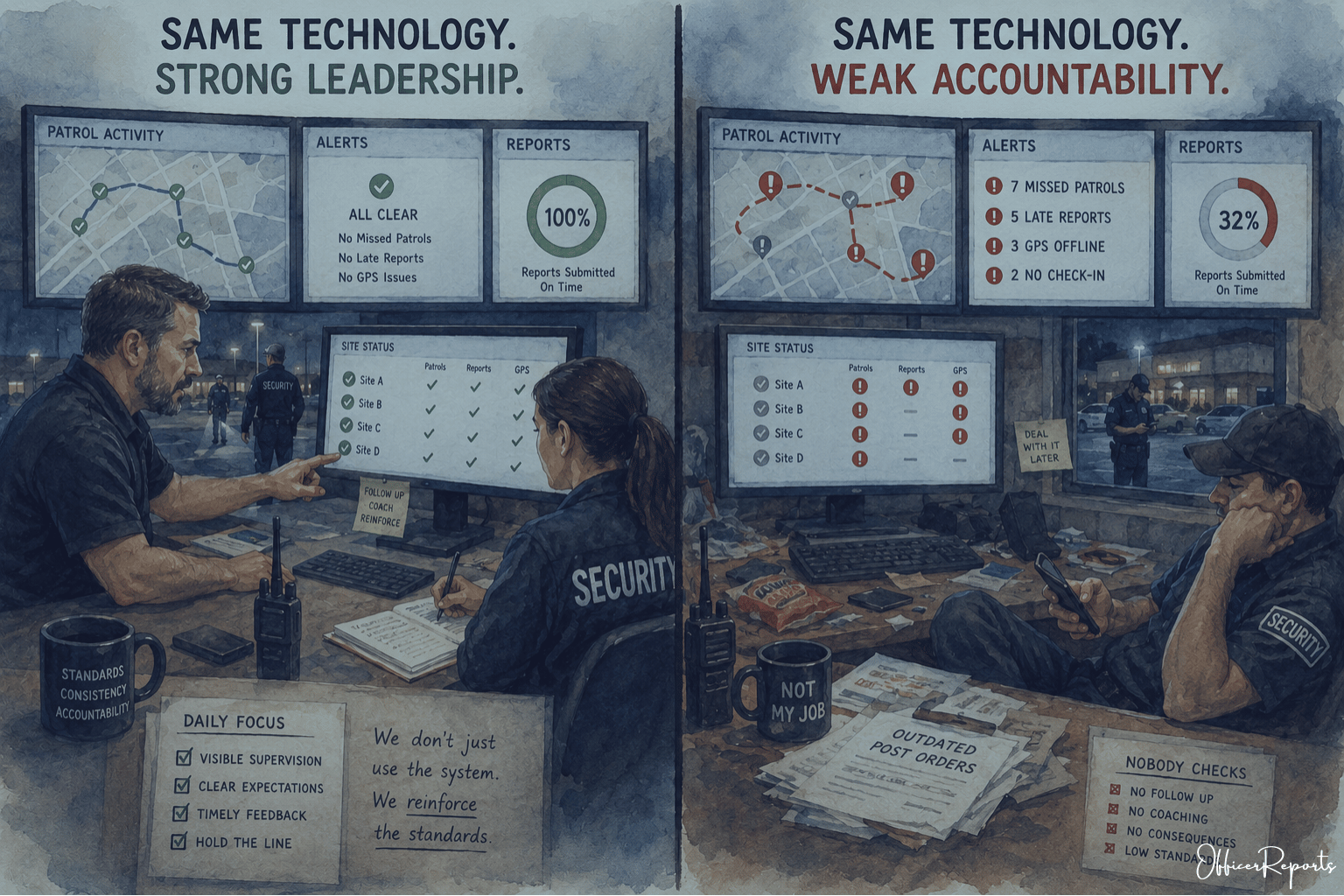
Why Technology Alone Does Not Improve Security Officer Accountability
Technology can strengthen visibility, reporting, and supervision, but it cannot replace strong leadership.
Many companies implement AI security guard software, expecting the technology itself to solve accountability problems. Yet those same companies sometimes allow officers to disable GPS tracking, bypass patrol requirements, ignore reporting standards, or refuse to properly use operational systems without meaningful correction.
In those situations, the problem is not the technology. The problem is inconsistent enforcement. Software cannot compensate for inconsistent supervision or leadership.
Operational systems are most effective when they reinforce standards that leadership is already committed to enforcing consistently. Without that discipline behind the system, technology often becomes another partially enforced process that employees learn how to work around.
This is why two companies can deploy similar operational software yet experience completely different results. One uses the system to consistently reinforce security officer accountability. The other implements the software without reinforcing the standards attached to it and hence, get different results.
What High Performing Security Companies Do Differently
Stronger operators tend to approach accountability differently from the beginning. They hire more selectively even when staffing pressure exists. They reinforce expectations early and repeatedly rather than assuming employees will absorb standards passively.
They also supervise more actively. Supervisors remain operationally visible rather than functioning solely as emergency responders. Performance conversations happen consistently, not only when problems escalate.
Operational clarity is another major differentiator between companies. Expectations are documented clearly. Post orders are usable. Reporting standards are specific. Accountability processes are predictable and fair. Officers understand both what is expected and how performance will be evaluated.
Importantly, stronger companies separate accountability from emotion. Discipline is not reactive or personal. Standards are enforced consistently because consistency itself creates operational stability.
The Goal Is Not Motivation
One of the biggest mistakes companies make is treating security officer accountability primarily as a problem with motivation. It’s been my experience that motivation naturally fluctuates. Some days, employees feel highly engaged. Other days, they do not. It’s also been my experience that systems create consistency where motivation cannot.
So to me, the goal is not to constantly inspire the workforce. The goal is to build operational environments where accountability, clarity, reinforcement, supervision, and structure consistently evoke the desired behavior. Strong systems reduce reliance on an officer’s motivation, because expectations remain stable regardless of mood. Structure sustains performance more reliably than temporary motivation.
The Industry Often Asks the Wrong Question
The security industry often asks:
“Why are officers lazy?” or something very similar.
But that question frequently leads companies toward frustration instead of operational improvement. A better question is: “What systems consistently produce strong security officer accountability?”
That shift changes the focus from blaming individuals to evaluating operational design. It encourages leadership to examine hiring standards, supervision quality, accountability consistency, training systems, communication processes, and operational clarity.
In no way does any of this remove responsibility from officers themselves. Some employees will still fail regardless of the environment they are in. But repeated organizational outcomes rarely happen randomly. Consistent patterns usually reflect consistent conditions.
The Reality
There are officers in the security industry who should not be in the profession. Ignoring that reality would be dishonest. Some individuals consistently underperform regardless of training, supervision, or operational structure.
But many companies also underestimate how strongly leadership, systems, accountability, clarity, and reinforcement shape workforce behavior over time. Weak security officer accountability is often treated purely as a workforce problem when it can also be the predictable outcome of inconsistent operational environments.
The companies that consistently build stronger field performance usually do not rely on motivational speeches or hope for better employees. They are building operational systems that reinforce standards clearly and consistently throughout the organization.
Because in the end, security officers rarely perform above the standards consistently reinforced around them.
By Courtney Sparkman
 Courtney is the founder and CEO of OfficerApps.com, a security guard company software provider, specializing in security guard management software, and publisher of Security Guard Services Magazine. He is a renowned author and security industry syndicator who also hosts an active YouTube channel, helping thousands of his subscribers to grow their security guard services companies.