Security companies rarely enter a security guard management software trial casually. By the time an organization commits time and attention to evaluating a platform, there is usually a clear business motivation behind it. Reporting quality may be under scrutiny. Clients may be asking harder questions about proof of service or incident documentation. Supervisors may be struggling to maintain consistency across multiple sites and shifts. A trial is often initiated with the belief that the right security guard management software will bring structure and visibility to problems that have grown difficult to manage manually.
Yet a significant percentage of security guard management software trials do not result in adoption. In many cases, the conclusion is that the software was not the right fit. After observing this pattern across hundreds of security companies, a different explanation becomes difficult to ignore. Most trials do not fail because the security management software is inadequate. They fail because the organization was not prepared for what the software would reveal.
The Misplaced Expectation Behind Most Security Software Trials
The most common mistake made at the beginning of a security guard management software trial is the assumption that technology will correct operational behavior on its own. Many organizations expect that once officers are given a digital reporting tool, reports will naturally become clearer, more consistent, and more timely. Supervisors are expected to gain real time visibility without changing how they review or enforce standards. Clients are expected to trust reports simply because they are generated by software.
In practice, security guard management software does not correct behavior. It documents it. When a reporting system is introduced, it immediately exposes patterns that were previously obscured by paper logs, spreadsheets, or disconnected systems. Reports arrive late. Critical details are missing. Supervisory review is inconsistent. What once felt manageable becomes visible and measurable.
This moment is often uncomfortable, and that discomfort is frequently attributed to the platform rather than the underlying operational process.
What Security Guard Management Software Actually Changes During a Trial
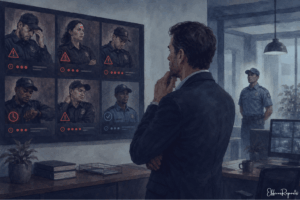
A trial of security guard management software does not introduce new problems into a security operation. It brings existing ones into focus. When officers submit vague or incomplete reports, the system captures that reality. When supervisors fail to review incident reports promptly, the delay becomes traceable. When accountability for report quality is unclear, the gaps become evident across sites and shifts.
For organizations that have relied on informal oversight, this level of visibility can feel like friction. The software appears demanding. Adoption feels harder than expected. The trial stalls not because the security guard management system is malfunctioning, but because it is accurately reflecting how work is currently being done.
At this stage, many teams decide that the software is too complex or not aligned with their operation. In reality, the software is doing exactly what it is designed to do.
Why Process Must Come Before Security Guard Software
Successful trials share one defining characteristic. They are grounded in process before technology is introduced. Security companies that see value during evaluations have already established clear expectations around reporting standards, supervisory review, and accountability. Officers understand what constitutes a complete and acceptable report. Supervisors understand when and how reports must be reviewed. Management has defined what information matters to clients and why.
When security guard management software is introduced into this environment, it becomes an enabler rather than a source of friction. The trial serves to validate that the platform supports existing discipline rather than attempting to create it from nothing.
Without this operational foundation, even the most capable security guard management software will struggle to gain traction.
How Strong Security Companies Evaluate Security Guard Software
Organizations that adopt security guard management software successfully tend to approach trials as a confirmation exercise rather than a cure. They are not testing whether the software will fix reporting problems. They are testing whether it reinforces standards they are already committed to enforcing.
This shift in mindset changes the outcome of a trial. Adoption becomes less about feature comparison and more about alignment with operational reality. The evaluation focuses less on dashboards and alerts and more on whether the system supports consistent officer behavior, timely supervisory review, and defensible documentation.
The critical question becomes whether the organization is prepared to support the level of accountability that security guard management software makes visible.
The Long Term Cost of Failed Software Trials
Repeated failed trials of security guard management software carry consequences that extend beyond the evaluation period. Each unsuccessful attempt increases skepticism within the organization. Officers become resistant to new reporting tools. Supervisors lose confidence in change initiatives. Management begins to accept weak reporting and limited visibility as unavoidable realities of the business.
Over time, this resignation creates measurable risk. Inconsistent documentation erodes client trust. Delayed incident review increases liability exposure. Missed details compound into larger operational failures. These outcomes are rarely attributed back to the absence of process, but the connection is direct.
A More Productive Way to Approach Security Guard Management Software Trials
A security guard management software trial should not be viewed as a test of whether a platform can impose order on disorganized operations. It should be treated as an opportunity to assess readiness. Security companies that ask whether their internal expectations are clear, enforceable, and consistently applied gain value regardless of the outcome of the trial.
When organizations approach evaluations with this perspective, even a decision not to move forward provides clarity. Clear processes and defined accountability are never wasted, and they position the company to succeed when the timing and conditions are right.
In the next article, we will examine why security guard management software trials often stall at the operational level and how supervisory behavior frequently determines whether a platform succeeds or fails.
By Courtney Sparkman
 Courtney is the founder and CEO of OfficerApps.com, a security guard company software provider and publisher of Security Guard Services Magazine. He is a renowned author and security industry syndicator who also hosts an active YouTube channel, helping thousands of his subscribers to grow their security guard services companies.