
Most security company owners already know turnover is expensive. They see it every week in the schedule, in the overtime report, in the recruiting pipeline, and in the frustration of supervisors who are constantly trying to keep posts covered. But what many owners do not always see clearly is how turnover affects security contract pricing. When officer turnover is high, the costs do not stop with recruiting and training. It can change the company’s payroll burden, raise the true cost of service, and make security contract pricing more difficult and less profitable.
When an officer leaves, the immediate concern is usually operational: Who can work the shift tonight? How quickly can we find a replacement? What do we tell the client if the site has another new face next week? Those are real problems, and any owner who has operated a guard company knows they can consume an enormous amount of management time.
But turnover is not just a staffing problem. It is also a financial problem, and some of its costs are much less obvious than others. Most companies think about the visible costs first. They think about job ads, interviews, background checks, uniforms, onboarding, training, overtime, and supervisor time. All of those costs matter. But one of the least-discussed financial consequences of security officer turnover is the way it can affect SUTA, or state unemployment tax.
That may not sound like the kind of issue that changes the direction of a company, but in a labor-heavy business with thin margins, small differences in labor burden can make a real difference. Retention is not just an HR goal. It is a financial strategy that can lower your cost of doing business, protect your margins, and improve the way you approach security contract pricing.
The Visible Costs of Officer Turnover In Security Contract Pricing
Security guard companies do not need to be convinced that turnover creates pain. When officers leave, somebody has to recruit replacements. Somebody has to review applications, conduct interviews, coordinate background checks, issue uniforms, complete onboarding, and get the new officer ready for the site. If the replacement is not ready quickly enough, another officer may have to work overtime, or a supervisor may have to cover the post.
Those costs are easy to understand because they show up in the daily operation. They show up in payroll, in overtime, in supervisor workload, and sometimes in client complaints. They also show up emotionally, because constant turnover wears people down. Dispatchers, schedulers, supervisors, and account managers all feel the pressure when the schedules for the same sites have to be redone over and over again.
The problem is that visible costs can trick owners into thinking they are seeing the full picture. In reality, the visible cost of security officer turnover is only the beginning. Turnover can also change the cost structure of the company in ways that are easy to miss if you are only looking at the schedule.
The Payroll Cost Most Security Companies Rarely Discuss
SUTA is a state unemployment tax paid by employers to help fund unemployment benefits. Depending on the state, it may also be referred to as state unemployment insurance, SUI, reemployment tax, or something similar. Regardless of the terminology, the basic business issue is the same: employers pay unemployment taxes as part of their payroll burden.
In many states, employers pay this tax on each employee’s wages up to a taxable wage base. The employer also has an assigned tax rate. That rate may be influenced by several factors, including state-specific rules, industry, the employer’s experience rating, and unemployment claims history.

For a security guard company, SUTA matters because payroll taxes are not abstract accounting items. They are part of the cost of delivering every billable hour. When you build a bid, you are not only pricing the officer’s wage. You are pricing payroll taxes, insurance, uniforms, supervision, administration, recruiting, training, and the margin needed to keep the company healthy.
For owners who care about security contract pricing, that matters because the unemployment tax is not separate from the bid. It is part of the labor burden behind every billable hour. If one company has a lower labor burden than another, it has more room to compete. It may be able to bid more aggressively, protect more margin, or absorb unexpected costs more easily. That is why SUTA deserves attention. It is not just a payroll department issue. It is part of the economics of the business.
The First SUTA Problem: A Higher Experience Rate
The first way turnover can hurt a security company is through the experience rating side of unemployment taxes. In many states, unemployment claims can affect the employer’s experience rating. When former employees file claims and those claims are charged to the employer, the employer’s future unemployment tax rate may be affected depending on that state’s formula.
This is where turnover can become more expensive than it looks on the surface. A company may believe it only lost money on recruiting, uniforms, and overtime, but the cost can continue after the officer is gone. If turnover contributes to more unemployment claims and those claims affect the company’s rate, the business may pay more in unemployment taxes going forward.
That matters during bidding. Security is a competitive industry, and many contracts are won or lost on a narrow difference in hourly billing rates. A company with a higher unemployment tax burden has to account for that cost somewhere. It either builds it into the bid and risks being less competitive, or it underprices the contract and accepts a thinner margin.
Neither option is attractive. High turnover does not just cost money after the contract is won. It can make the next contract harder to win.
The Second SUTA Problem: Never Reaching the Taxable Wage Base
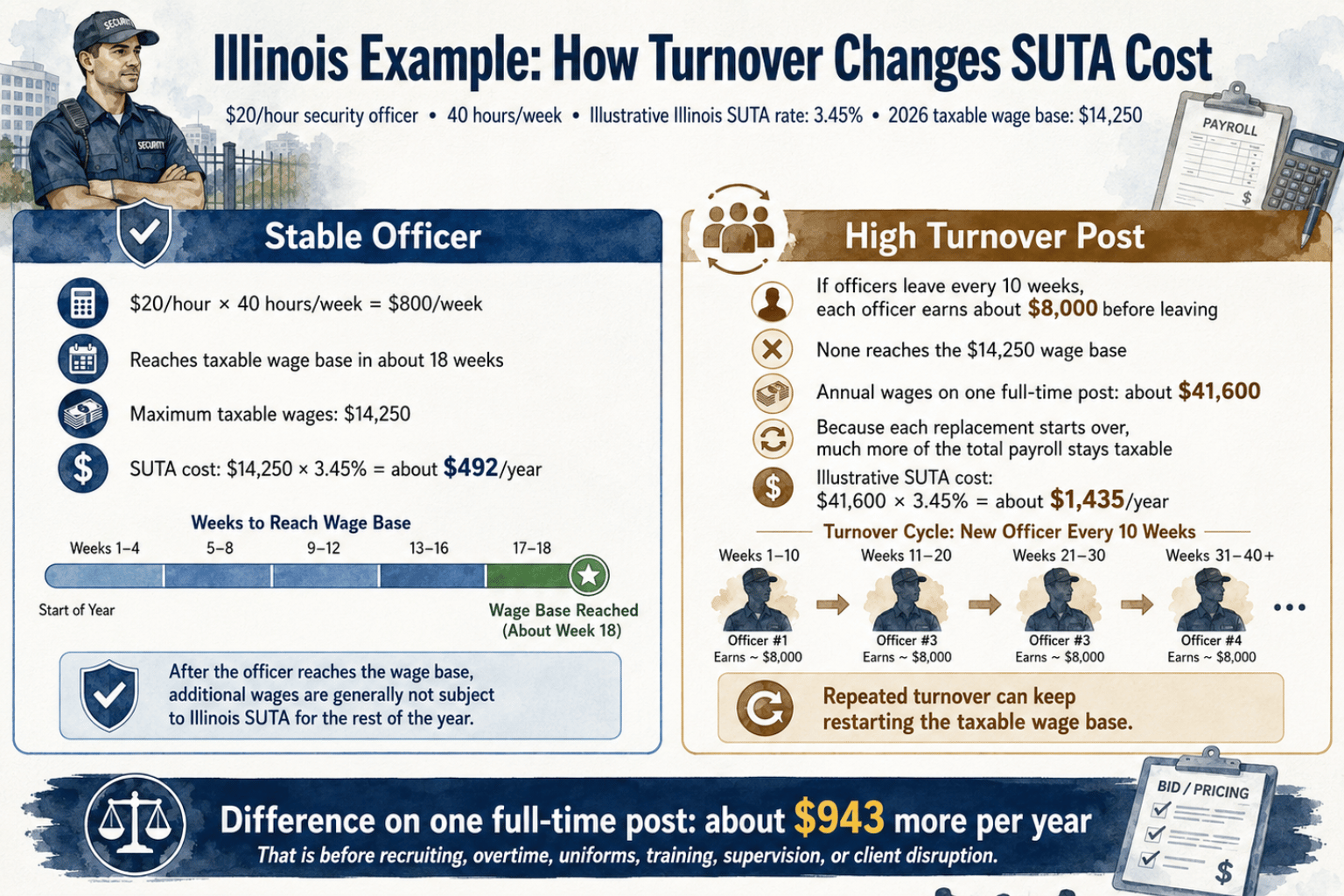
The second SUTA problem is less obvious, but it may be even more important for companies with heavy officer churn. In many states, employers pay SUTA only on each employee’s wages up to that state’s taxable wage base for the year. Once an employee earns beyond that threshold, the employer generally stops paying SUTA on additional wages for that employee for the rest of the year.
That structure can reward stability. If an officer stays with the company long enough to reach the taxable wage base, the company may no longer owe SUTA on that officer’s additional wages for the rest of the year. But if officers leave before reaching the threshold, replacement employees start the calculation over again.
That means a high-turnover company may keep paying SUTA on a larger share of its total wages because it is constantly cycling through new employees. Instead of having a stable group of officers who eventually exceed the taxable wage base, the company keeps adding replacement officers whose wages are still inside the taxable portion.
This is one of those costs that can hide in plain sight. It does not show up as a single line item called “turnover penalty.” It shows up as a higher labor burden across the company. The company may be paying unemployment tax more often, on more employees, and on a larger portion of payroll than it would if its officers stayed longer.
That is not just a tax issue. It is a retention issue, a pricing issue, and a margin issue.
Why SUTA Matters in Security Contract Pricing
Security contract pricing is already difficult because the business is so labor intensive. In many cases, the officer’s wage drives the largest part of the price, and the remaining margin has to cover everything else: payroll taxes, workers’ compensation, general liability, uniforms, supervision, recruiting, administration, technology, and profit.
When margins are tight, small differences matter. A few cents or a few percentage points in labor burden can change the economics of a contract. A company with lower turnover may have a lower effective cost structure because it is spending less on recruiting, less on overtime, less on retraining, and potentially less on avoidable unemployment tax costs.
This is why retention can become a pricing advantage. Two security companies may bid the same hourly bill rate, but the company with better retention may keep more of that rate as profit. It may also have more room to make strategic pricing decisions without putting the business at risk.
That point is easy to underestimate. Many owners think of retention as something that improves morale and reduces stress. It does. But it can also create financial flexibility. A company with more stable officers has a better chance of building predictable labor costs into its bids. A company with constant churn is often pricing contracts while chasing costs it does not fully control.
How Turnover Raises Your Break-Even Point
SUTA is only one example of a larger business problem. Turnover raises your break-even point. Every replacement officer brings a collection of costs that must be absorbed somewhere in the business.
Recruiting costs go up. Overtime pressure increases. Supervisors spend more time filling holes and less time improving performance. Training becomes repetitive. Clients see inconsistency. Good officers get burned out from covering extra shifts. Schedulers become reactive. Account managers spend more time explaining disruptions than strengthening relationships.
Each of these costs changes what it actually takes to profitably deliver one hour of security service. The company may still be billing the client the same rate, but the cost to produce that hour has increased. When that happens often enough, profit disappears quietly.
This is one of the reasons some companies feel busy but not profitable. They are winning work, filling posts, and generating revenue, but the underlying cost structure is working against them. Turnover keeps pulling money out of the business before it can become margin, investment, or cash flow.
That is why security contract pricing should not be based only on the officer wage and standard labor burden assumptions. If the company’s real cost of service is being pushed higher by turnover, the pricing model needs to reflect that reality.

Why Employee Retention Is a Competitive Advantage for Security Companies
Most companies talk about retention because it is good for culture. That is true, but it is not the whole story. Retention is also a competitive advantage because it stabilizes the business financially.
A company that retains officers longer may reduce replacement costs, lower overtime pressure, improve client consistency, stabilize supervision, and reduce avoidable payroll burden. It may also improve the quality of service because officers who stay longer understand the post, the client, the reporting expectations, and the small details that make a site run well.
That kind of stability compounds. Supervisors can spend more time coaching instead of constantly replacing. Account managers can focus on building client relationships instead of apologizing for turnover. Owners can make better pricing decisions because the cost structure is more predictable.
In a market where too many companies are forced into competing on price, this matters. Retention gives a company more control over its numbers. It does not eliminate competitive pressure, but it can create room to operate with more discipline.
What Owners Should Review As Part of Their Security Contract Pricing
The goal is not to turn security company owners into tax experts. The goal is to help owners ask better questions about the financial impact of turnover.
Start by understanding your current SUTA rate and how it compares with prior years. Review your state’s taxable wage base and how many officers typically stay long enough to reach it. Look at your unemployment claims history and whether former employee claims are affecting your experience rating. Then compare those numbers against your turnover rate, average officer tenure, and the cost assumptions you use when bidding contracts.
This review should involve your payroll provider, accountant, or state workforce agency because the details vary by state. But the business question is straightforward: Is officer turnover increasing your labor burden in ways that are not fully reflected in your pricing model?
Any serious review of security contract pricing should include the company’s real turnover costs. Many security companies price contracts using standard assumptions for payroll taxes and labor burden. That approach may be fine when the assumptions are accurate. But if turnover is changing the real cost of labor, the model may be giving the owner a false sense of margin.
That is dangerous because it can lead to underpricing. A contract may look profitable on paper while the company is quietly absorbing higher costs through overtime, recruiting, supervision, training, and unemployment taxes. By the time the owner sees the problem clearly, the contract may already be locked in at a rate that does not support the actual cost of service.
The Hidden Cost Becomes a Strategic Lesson
Most security companies know turnover is painful. Fewer understand how deeply it can affect pricing, margins, and competitiveness. SUTA is only one example, but it illustrates the larger issue clearly.
Every officer who leaves can affect more than the schedule. They can affect the company’s cost structure. They can increase management workload, reduce consistency, create client risk, and potentially increase payroll-related costs that follow the company into future bids.
That is why retention should be viewed as more than an HR metric. In a labor-heavy business with thin margins, retention is part of the financial foundation of the company. It influences how efficiently the company operates, how accurately it prices work, and how much room it has to compete without sacrificing margin.
Every security company talks about reducing turnover because it is good for morale. Fewer talk about it as a way to become more competitive. But the companies that understand the financial side of retention have an advantage. They are not just trying to keep officers because it feels better operationally. They are protecting the economics of the business.
SUTA is only one example, but it shows why security contract pricing cannot be separated from retention. If turnover increases your labor burden, raises your break-even point, and makes future bids harder to price accurately, then officer retention becomes part of your financial strategy.
Before closing, it is important to be clear about one thing: SUTA rules vary by state. Tax rates, taxable wage bases, experience-rating formulas, unemployment claim rules, and employer obligations are not identical across the country. The discussion in this article describes the general way state unemployment taxes often affect employers, but security company owners should consult their payroll provider, accountant, or state workforce agency for guidance specific to their state.
Because SUTA rules vary from state to state, I would be interested in hearing how this works where you operate. If your state handles unemployment taxes differently, leave a comment and share what security company owners should know.
By Courtney Sparkman

 Courtney is the founder and CEO of OfficerApps.com, a security guard company software provider, specializing in security guard management software, and publisher of Security Guard Services Magazine. He is a renowned author and security industry syndicator who also hosts an active YouTube channel, helping thousands of his subscribers to grow their security guard services companies.