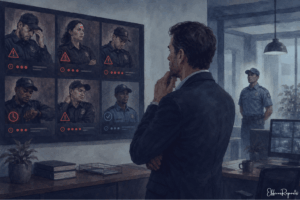
A client loses confidence after a preventable incident. A supervisor spends the night covering open shifts instead of managing operations. Another experienced officer leaves after only a few months because the security guard pay rate at the site is no longer enough to justify staying, forcing the operation back into another cycle of hiring, retraining, and instability.
Most security company owners have lived through some version of this cycle.
At first glance, these problems appear disconnected. Staffing shortages feel like a recruiting issue. Inconsistent performance feels like a training issue. Client frustration feels like an operational issue. But underneath many of these challenges is a larger structural reality the industry has yet to solve.
The security industry increasingly expects professional-level performance while operating inside pricing structures that often make long-term workforce stability difficult to maintain.
In 2026, the year of private equity and artificial intelligence, that tension is becoming harder to ignore.
Clients expect officers who can de-escalate situations, communicate professionally, manage incidents, operate technology platforms, and represent their brand effectively. Yet many companies are competing in markets where security guard pay rates remain heavily compressed by procurement pressure and commodity-like purchasing decisions.
This article is not about blaming clients or criticizing security companies. Most operators are navigating highly competitive environments with thin margins and constant pricing pressure. But the industry still faces an important question:
Can security guard service buyers continue expecting high performance from unstable labor systems with low security guard pay rates?
The Industry’s Expectations Have Changed
The role of the security officer has evolved significantly over the past two decades. In many environments, officers are no longer viewed as passive observers whose primary responsibility is simply maintaining presence. Today’s officers are often expected to function as customer service representatives, incident responders, access control specialists, report writers, and operational extensions of the client organization itself.
A modern officer may be responsible for:
- de-escalating workplace conflicts,
- responding to medical emergencies,
- documenting incidents professionally,
- monitoring surveillance systems,
- managing visitor interactions,
- enforcing site procedures,
- and communicating effectively with employees, tenants, and first responders.
The expectations are understandable. Clients want professionalism, consistency, and accountability because the environments officers protect have become more complex and higher risk.
The challenge is that many parts of the industry still operate within economic models that prioritize aggressive pricing competition above long-term workforce stability.
That reality directly affects the security guard pay rate companies are able to offer and influences nearly every downstream operational outcome.
The Stability Problem Behind the Industry
A recent report from the Center for American Progress highlighted several trends pointing toward a broader workforce stability problem within the security industry. Among the report’s findings was that security officer wages have remained largely stagnant for roughly two decades at around $17 per hour, even as living costs have continued increasing.
The report also found that annual turnover across the industry exceeds 50 percent, and depending on the circles that you run in, I’ve heard numbers as high as 200%.
That level of turnover is not just a staffing concern. It creates operational instability throughout the business. When officers cycle through sites constantly, companies are forced into repeated recruiting, onboarding, and retraining efforts. Supervisors spend more time filling gaps and less time improving performance. Site familiarity weakens and operational consistency becomes harder to maintain.
The report further noted that contracted officers generally earn lower wages and receive fewer benefits than officers directly employed by the organizations they protect.
Why Security Guard Pay Rates Affect Operations
The discussion around security guard pay rates is often reduced to a simple debate about wages. In reality, compensation affects nearly every operational layer inside a security company.
When turnover becomes constant, operations become increasingly reactive.
Experienced officers leave. New officers require additional oversight. Supervisors spend more time managing staffing instability. Site specific knowledge disappears repeatedly and must constantly be rebuilt.
A lower security guard pay rate may help a proposal remain competitive in the short term, but the hidden operational costs often surface later through:
- inconsistent execution,
- weaker post-order familiarity,
- increased supervisory burden,
- higher retraining costs,
- reduced accountability,
- and lower client confidence.
Over time, instability creates drag throughout the organization. That is why workforce stability should not be viewed solely as an HR issue. It is an operational infrastructure issue.
The Pricing Structure Behind the Problem With Security Guard Pay Rates
Security is frequently purchased like a commodity service. When multiple proposals appear similar, buyers naturally focus on price. Procurement teams are often measured on cost control, and choosing a higher priced provider can become difficult to justify if operational differences are not clearly visible. This creates pressure throughout the industry.
Security companies compete inside systems that reward lower labor costs and compressed pricing structures. Those pressures directly influence the security guard pay rate that companies can sustain while remaining competitive in the market.
Most operators are not intentionally trying to underpay officers. In many cases, companies are simply responding to economic realities created by competitive bidding environments.
But the long term consequence is an industry that often expects professional level performance while struggling to create long term workforce stability.

Why Stability Matters More Than Most Companies Realize
Long term officer stability creates operational advantages that are difficult to replace quickly. Experienced officers develop familiarity with the site, client expectations, tenants, vendors, procedures, and patterns of activity. They become more effective because they understand the environment deeply.
Clients notice this consistency.
An officer who has spent years at a property typically handles incidents differently than someone still learning the site. Communication improves. Report quality improves. Accountability improves. Small operational problems are often identified earlier because experienced officers recognize abnormal activity more quickly.
This type of stability also strengthens relationships between officers, supervisors, and clients. Trust builds gradually over time, and consistent personnel often create stronger operational confidence across the entire account.
This is where the conversation around security guard pay rates becomes strategically more important. Compensation alone does not solve operational problems, but inadequate compensation structures often contribute directly to workforce instability.
The companies that create stronger retention and consistency are often the ones able to build more resilient long term operations.
Where Better Security Companies Separate Themselves
Despite the pressures facing the industry, some companies consistently maintain stronger operations than others.
The difference is rarely based on compensation alone. Better operators typically build stronger systems around:
- accountability,
- supervision,
- communication,
- training,
- operational visibility,
- and workforce support.
Technology increasingly plays a major role as well.
Companies that improve visibility into daily operations are often better positioned to maintain consistency across sites. Better reporting systems, stronger post order management, clearer communication workflows, and improved operational oversight help reduce many of the inefficiencies that contribute to instability. Over time, these operational improvements create differentiation that clients can actually see.
The conversation shifts away from simply comparing hourly rates and toward evaluating consistency, responsiveness, professionalism, and operational execution.
That is where stronger companies begin separating themselves from the bottom feeders.
The Real Question Facing the Industry and Security Guard Pay Rates
The security industry is evolving, but many of its economic structures still reflect older commodity based models.
Clients increasingly expect officers to function as trained professionals capable of handling complex situations, representing brands professionally, and operating within sophisticated environments. At the same time, procurement pressure continues to compress security guard pay rates across large parts of the market. Without a doubt, those realities have begun to collide and continue to do so.
The question is no longer simply whether officers should earn more money. The deeper question is whether the industry wants transactional labor systems or stable professional operations. Because professional operations require continuity.
They require experienced personnel, stronger accountability, operational consistency, and systems that support long term performance rather than constant replacement cycles.
The companies that recognize this will likely be the ones that build the most resilient operations and the strongest client relationships over time.
Closing
The conversation around security guard pay rates is ultimately about more than compensation alone.
It is about whether the industry can continue to expect and desire high levels of professionalism while operating within systems that often undermine workforce stability.
Clients want consistency. They want accountability. They want officers who understand their environment, communicate professionally, and handle situations effectively. But those outcomes become harder to sustain when instability becomes normalized.
The security companies that separate themselves in the long term will not simply be the ones with the lowest prices. They will be the ones who build stable operational systems capable of delivering consistent performance over time.
And increasingly, workforce stability may become one of the most important competitive advantages in the industry.
By Courtney Sparkman
 Courtney is the founder and CEO of OfficerApps.com, a security guard company software provider, specializing in security guard management software, and publisher of Security Guard Services Magazine. He is a renowned author and security industry syndicator who also hosts an active YouTube channel, helping thousands of his subscribers to grow their security guard services companies.